From the first conversation to the sofa taking its place in the living room runs through seven stages, each with its own point where a mistake is still cheap to fix.
The brief is a technical spec, not small talk
The conversation starts with habits, not a catalogue: who sits daily, whether the sofa doubles as a bed, whether there are children or pets at home — these answers shape filling and fabric before shape even enters the discussion.
Room and doorway dimensions are measured at this stage specifically to decide whether the frame ships as one piece or knock-down — getting this wrong is the costliest mistake in the whole process.
The brief takes thirty minutes to an hour and a half depending on complexity — a single chair needs a short conversation, while a full living room tied to a design project often needs an on-site visit, especially for an unusual alcove or irregular walls.
Samples you can actually touch
Fabric and wood-finish decisions are made from a physical 10×10 cm sample, not a screen photo — colour shifts more under different light than a monitor shows; clients get two or three curated options, not the whole catalogue, since too many choices slow the decision rather than improving it.
When a designer is involved, the sample set is matched to the project’s palette from references and drawings rather than a vague verbal description, which noticeably cuts the number of sketch revisions.
Sketch and approval: the cheapest stage to change your mind
The sketch carries exact numbers — seat depth, armrest height, back angle — and any change here takes an hour of a designer’s time rather than reworking a finished piece.
A preliminary quote — frame, filling, fabric, shape complexity, roughly in that order of cost impact — is approved before production starts, so the price does not shift mid-process without a separate conversation.
Both sides sign off on the approved sketch — not paperwork for its own sake, but a shared reference point: a month later, any question about what was agreed is answered by a specific drawing with numbers, not by memory.
The frame: joints checked by hand, not by eye
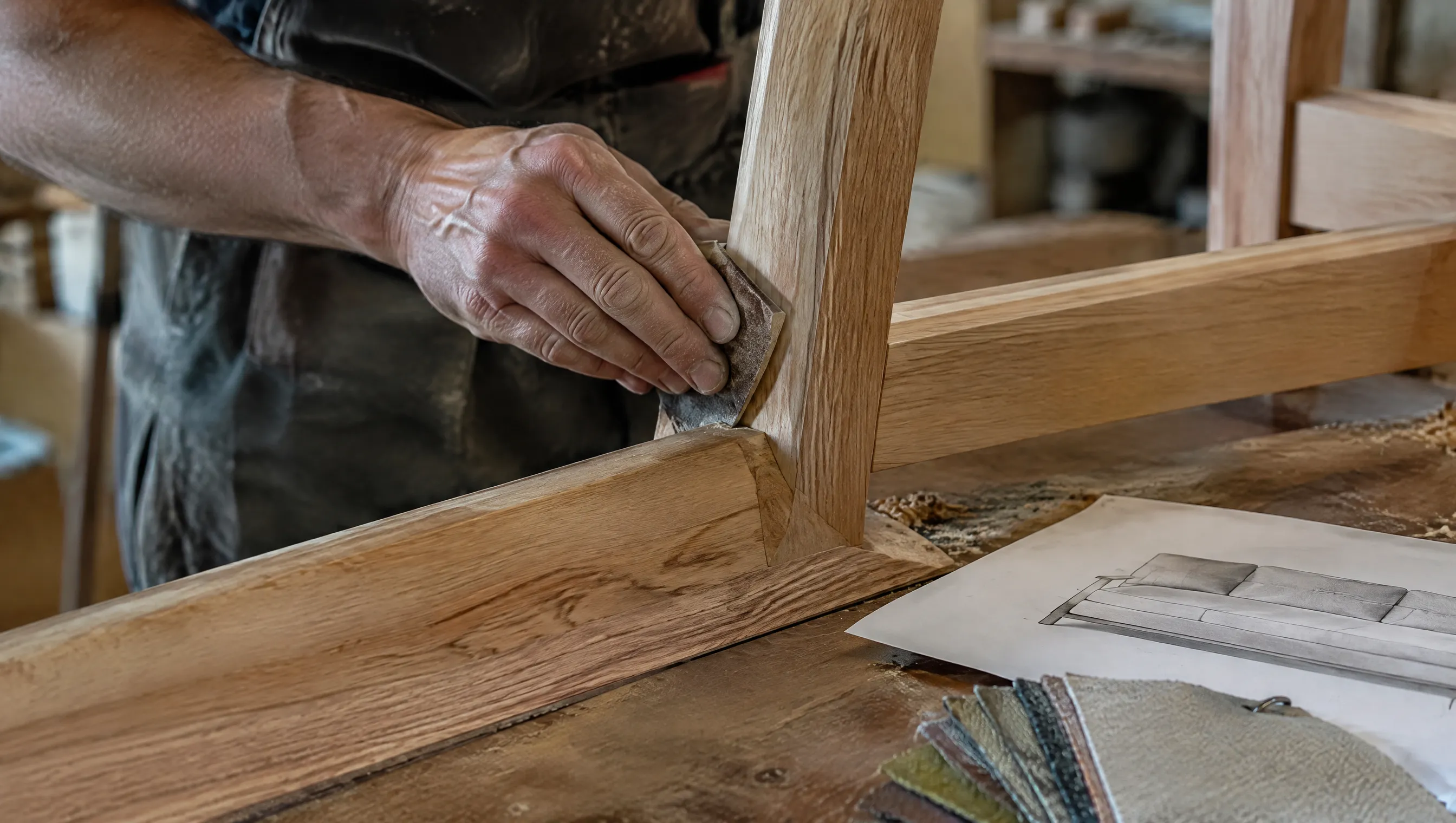
The frame uses solid beech or birch plus 15–18 mm birch plywood — a combination that resists humidity-driven cracking better than solid panels alone; corner joints are doweled and glued, reinforced with metal brackets only at high-load points.
After assembly, every joint is hand-checked for play — a weak glue seam can look fine visually but is felt by hand before it is ever seen, and fixing it now takes minutes, not a full reupholstering job later.
The finished seat is load-tested with weight well beyond normal sitting and held under it for a period, showing how the frame and webbing will behave years ahead, not just on day one — a sofa that fails goes back for rework before upholstery ever begins.
Filling: a construction, not a single layer
The seat layers foam of different densities — a firmer base (35–40 kg/m³) holding shape and load, a softer top layer (25–28 kg/m³) for initial comfort; one density alone either feels hard from the first sit or sags within a year or two.
Layers rest on elastic webbing stretched crosswise across the frame base, spreading weight rather than concentrating it; deeper lounge-depth models sometimes add an independent spring unit under the foam for a longer-lasting seat under daily use.
Layer density and thickness are matched to the specific household’s weight and habits, not just the model — a home where children jump on the sofa needs a different build than a study chair used by one adult sitting still, which is why two visually identical sofas can feel different to sit on.
Upholstery: cutting with the pile, tensioning by hand
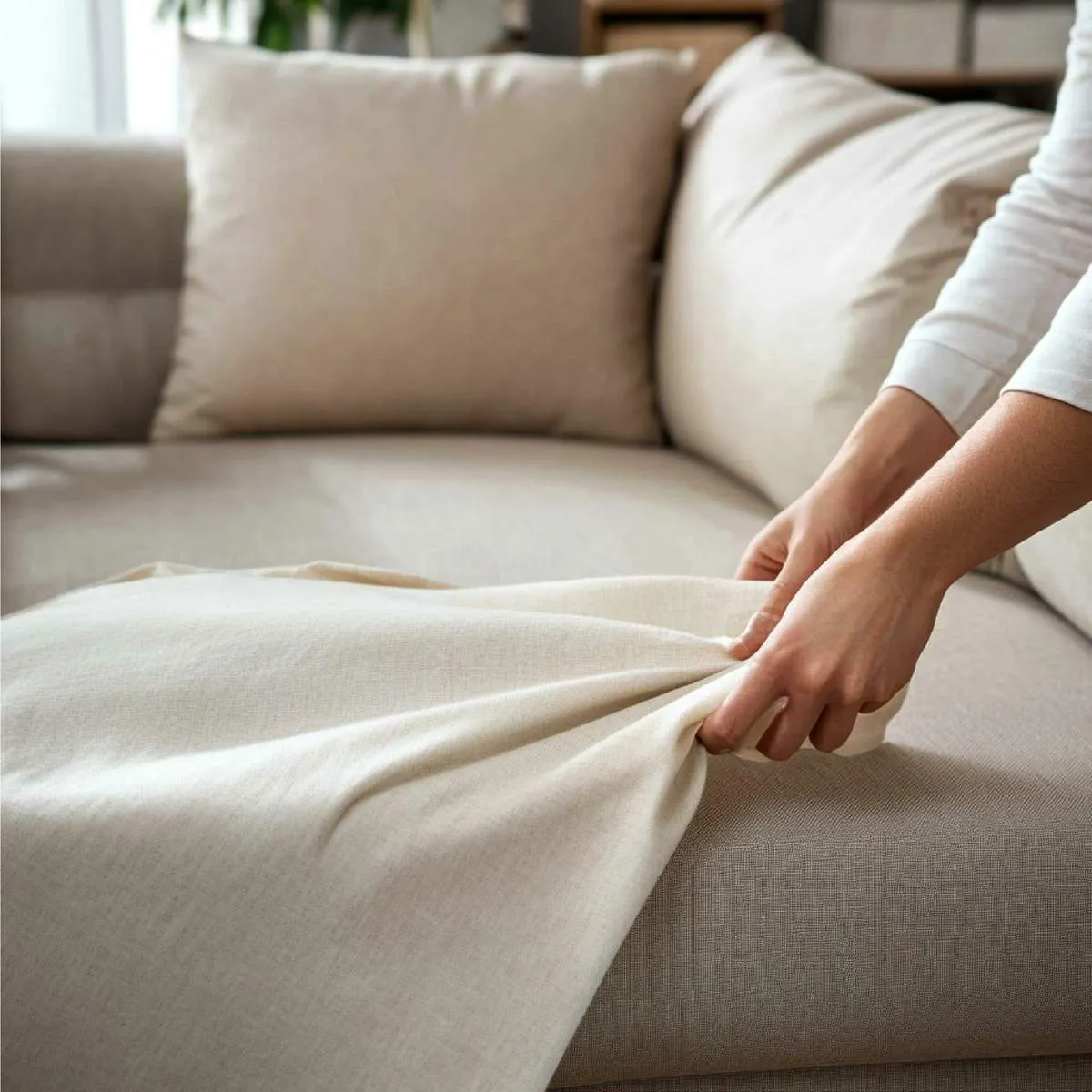
Every panel is cut along the fabric’s pile or pattern direction — mismatched panels catch light differently even to an untrained eye; fabric is hand-tensioned evenly along each seam, since uneven tension shows up as creases months later, not immediately.
A finished seam is checked under both direct and side-diffused light, since side light reveals small irregularities invisible under normal workshop lighting — the same ones a client would otherwise spot at home under different light.
Who actually works on one sofa
One sofa passes through four to six specialists — a design engineer, a woodworking machinist, a filling specialist and an upholstery seamstress — and at each handover the next craftsman checks the previous stage rather than simply continuing from where it stopped.
This division of labour is slower than one person doing everything, but each specialist builds deep expertise in a narrow operation that takes hundreds of repetitions to do confidently.
Final inspection: looking at it like a stranger would
- Geometry: diagonals are tape-measured — a 3–4 mm skew on a large model is visible from the end
- Fabric tone: panels cut from one roll are compared, since even one batch can shift tone slightly end to end
- Seams: checked again under side light, now on the finished piece
- Hardware and mechanisms: a fold-out mechanism or storage drawer is cycled several times to check smoothness
A sofa that fails even one of these checks does not ship — it goes back to the same craftsman who assembled it, slower than packing it as is but far cheaper and calmer than a post-delivery service call to a lived-in home.
Warranty: what it actually covers
A 24-month warranty on frame and mechanisms is standard for bespoke furniture — most assembly defects, if any occur, show up within that window, while ordinary fabric wear is treated as normal use rather than a warranty claim.
A creak, play in a joint, or a rough mechanism during the warranty period is usually fixed on site by a technician; returning the piece to the workshop is rare, needed mainly for serious frame damage rather than ordinary settling in the first weeks.
A warranty call needs no fresh briefing or paperwork gathering — just the order number, which keeps the piece’s whole history on file, from sketch and materials to exactly who assembled the frame and upholstered it.
Delivery and placement
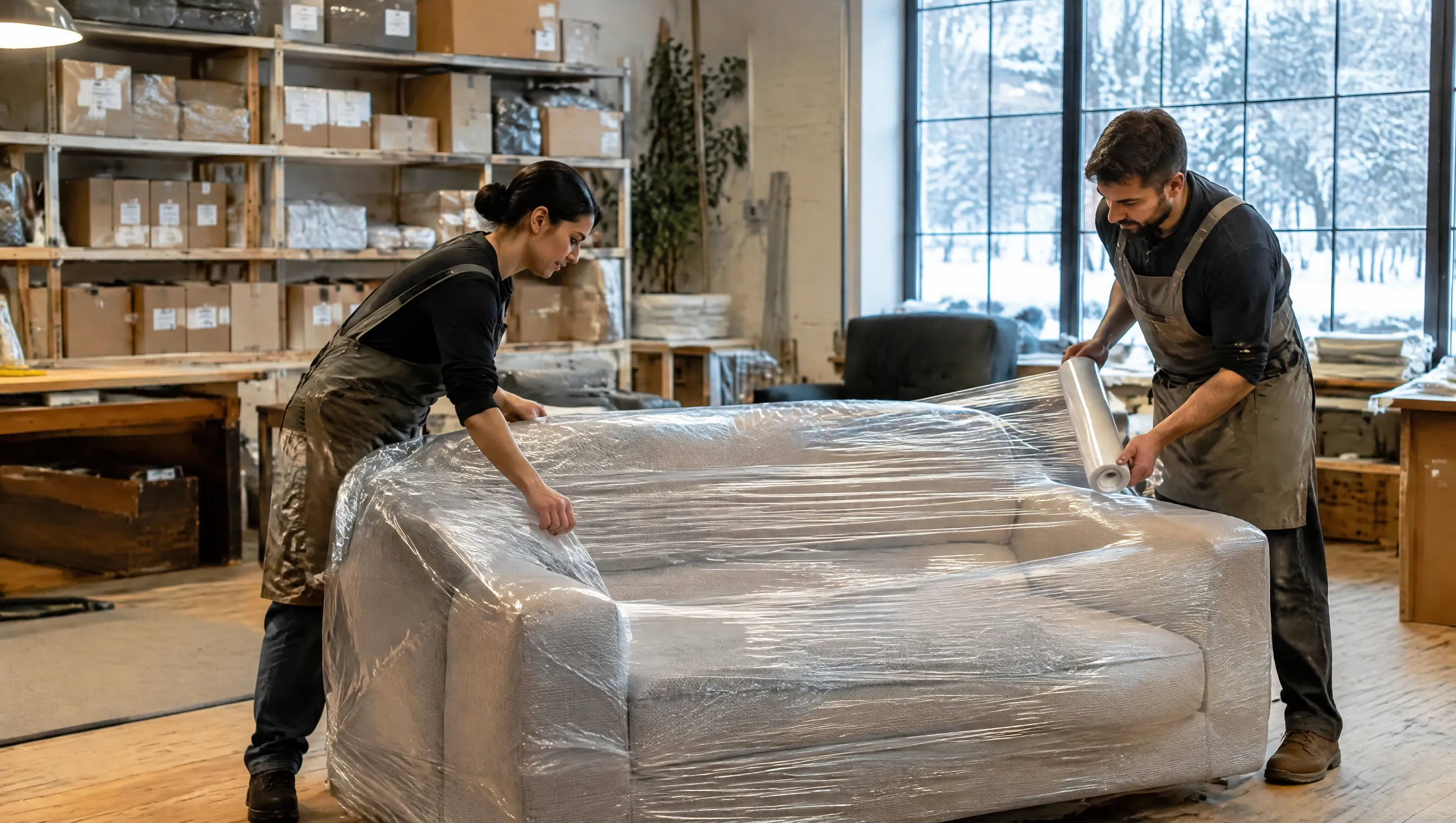
The finished piece is multi-layer wrapped — stretch film, cardboard edge guards, a soft outer cover — and delivered by transport sized to that specific model; on site the crew reassembles knock-down pieces and places furniture exactly where the sketch-stage measurements planned, not just wherever it fits.
Before the crew leaves, the sofa is checked once more in the actual room, not under workshop lighting — fabric can read slightly differently in daylight, and any small adjustment the client wants happens on the spot rather than as a separate visit.
Why this is not always pricier than ready-made
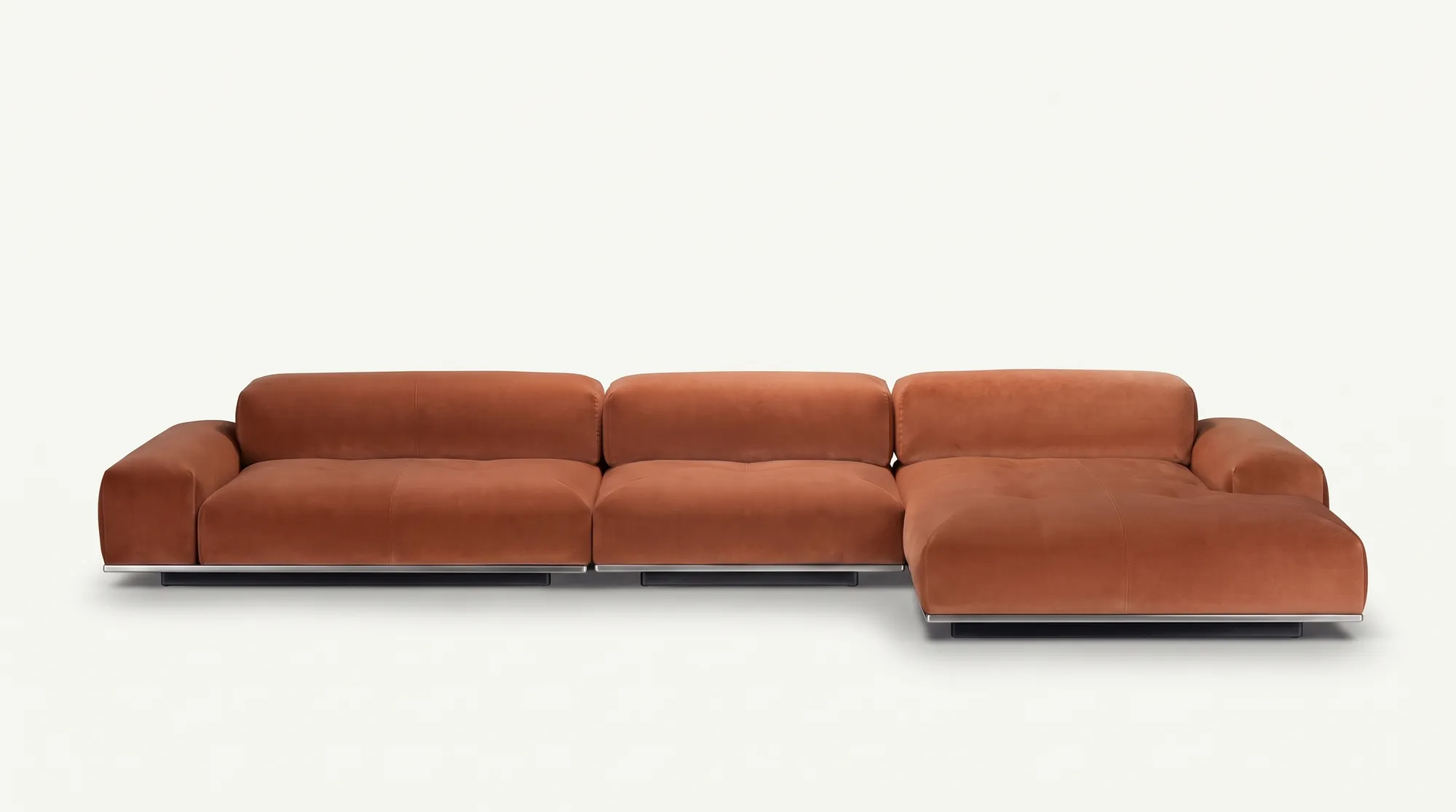
The price gap versus good ready-made furniture mainly comes from fabric, filling and shape complexity, not the fact of custom manufacture itself — a custom model with standard materials can cost comparably while fitting the room exactly.
Where custom work genuinely costs more — complex modular shapes, rare imported fabric, custom metalwork — that difference is known upfront in the quote, not discovered mid-production.
Custom manufacture, in turn, is almost never limited to a catalogue’s fixed size range — the sofa fits the room, not the other way round.
What can change after production starts, and what cannot
Before cutting and frame assembly, almost anything can change — size, material, colour, a sleep mechanism; once upholstery has begun, a fabric swap means starting over, since cut fabric cannot go back on the roll, so the contract marks the point after which changes become a new order rather than an edit.
The cutoff exists so both sides understand exactly what a given change costs at a given stage, rather than discovering after the fact why price or timeline shifted.
Small tweaks, like leg height within the same mount, can sometimes still be made even at final inspection without touching the upholstery.
Timeline by stage
A standard sofa takes 5–8 weeks from approved sketch to delivery — one week for the brief and sketch, one to two for the frame, one to three more for filling and hand upholstery, with custom fabric or complex metalwork adding one to two weeks.
A note from a KALLEN HOME workshop craftsman
"A client sees the finished sofa once; we see it at every one of seven stages, and at each one a small flaw either gets fixed in ten minutes or gets passed on to quietly become an expensive, slow rework. The whole production discipline is built around that one fact," says the workshop team.
Frequently asked questions
How many stages does a sofa go through from order to delivery?
Seven: brief and sample selection, sketch and quote, frame, filling, upholstery, final inspection, delivery and placement.
At which stage are changes cheapest to make?
At the sketch stage — a size or shape change takes a designer an hour, not a rework of a finished piece.
Why are frames checked by hand and not just by eye?
Weakness in a glue seam or fastener is felt by hand before it becomes visible, letting the joint be fixed in 10–15 minutes.
What makes up the seat filling?
Several layers of foam at different densities on elastic webbing, sometimes with an independent spring unit for a deeper seat.
What gets checked before a sofa ships to the client?
Frame geometry, fabric tone matching between panels, seam quality under side light, and smooth operation of mechanisms and hardware.
Until when can fabric or size still be changed?
Up until fabric cutting and frame assembly begin — after that, changing material means starting over almost from scratch.