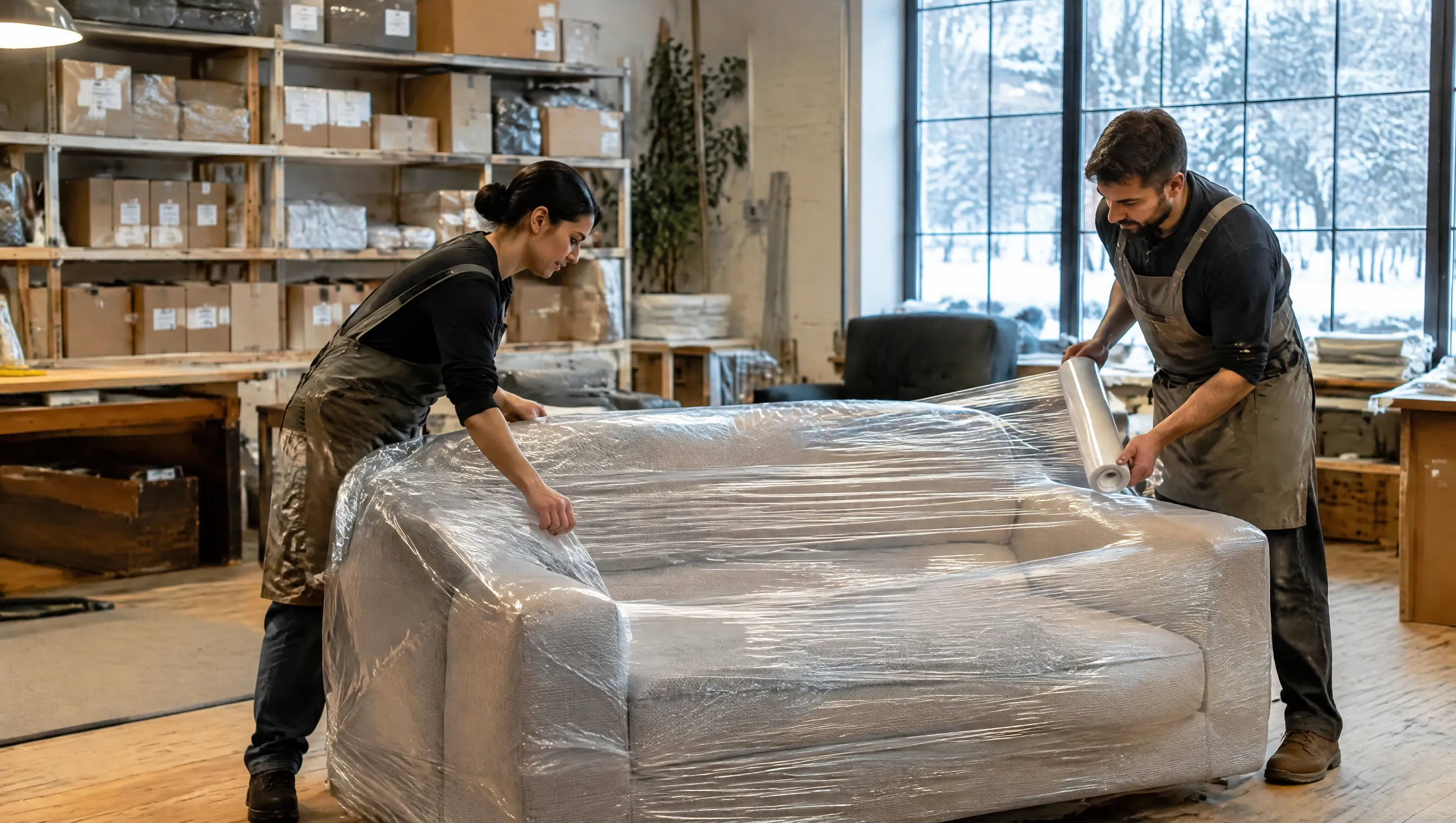
Every frame is hand-checked for joint play and load-tested at the seat before upholstery, while a defect is still cheap to fix.
Why we explain a check the client never sees
A client either trusts the frame inside the finished sofa or does not — the check itself is invisible, so we would rather explain it in detail than print an unverifiable "sturdy frame" label like every competitor does.
The gap between the word "sturdy" in a product description and an actual check protocol is invisible in a showroom but shows up at home two, five and ten years after purchase.
Frame strength talk usually reduces to wood species — solid vs chipboard, oak vs pine. That is only half the story: even solid wood can be assembled with play if a joint is glued or fastened carelessly.
Filming every order is impractical, but the protocol itself can be shown: exactly what gets checked, in what order, and the threshold for "rework" versus "pass" — that protocol follows below, step by step.
Checking joints by hand, not by eye
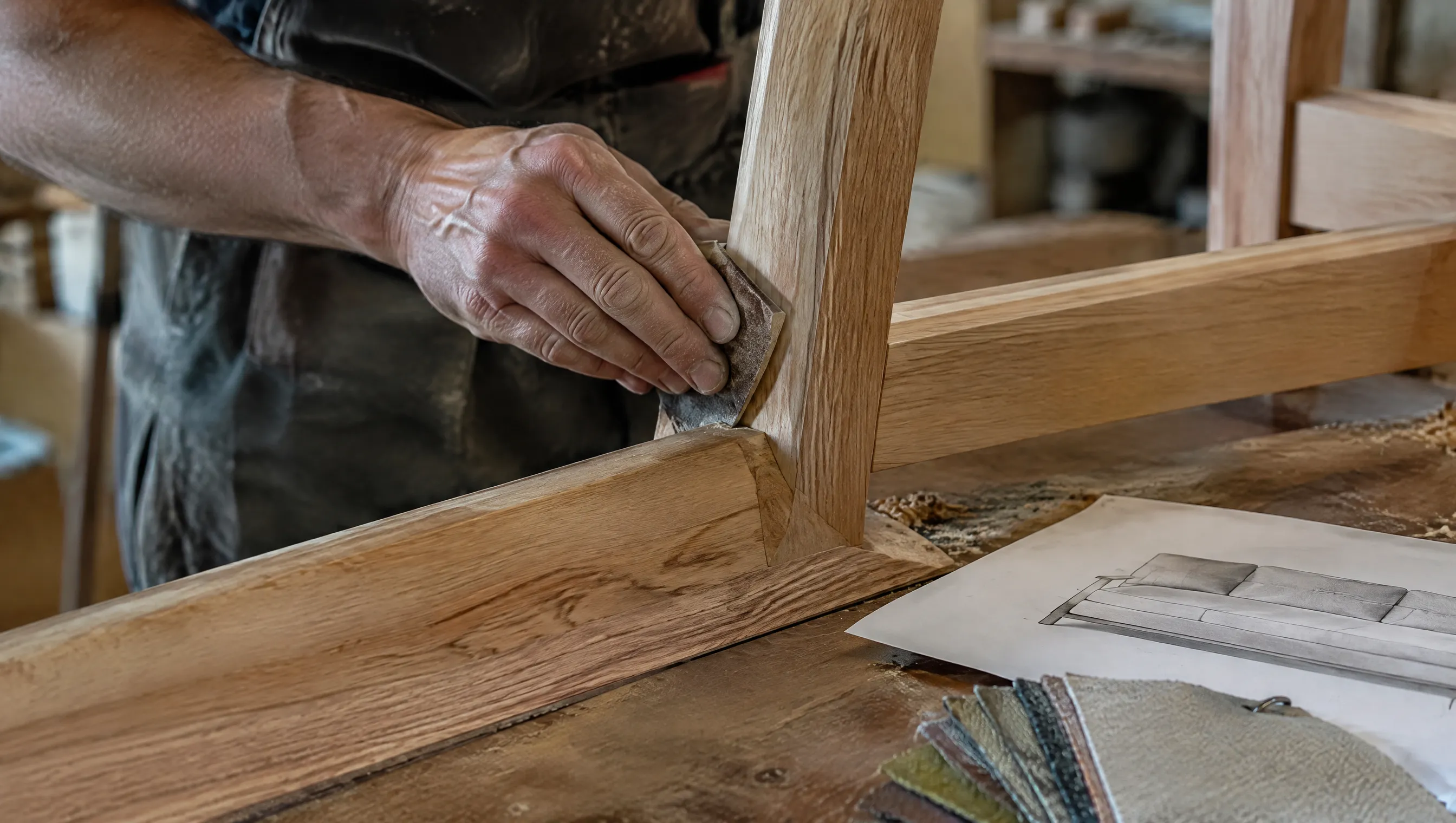
A craftsman rocks every corner joint by hand, feeling for the slightest play — 20 to 40 minutes per frame, every joint checked individually, not sampled.
Load-testing the seat: which benchmarks we follow
EN 1728, the European upholstery-testing standard, specifies roughly 800 N of static load on the seat’s front edge and cyclic durability testing around 20,000 cycles; our in-house load test follows the same principle without full lab certification on every unit, which would make bespoke furniture prohibitively expensive.
800 N is roughly 80 kg concentrated on the seat’s front edge rather than spread across it — edge-concentrated load stresses webbing and frame differently than the same weight spread over the centre, and the edge scenario is the more realistic one: people sit at the edge before leaning back.
Stability check: a sofa must not tip
A separate check, conceptually similar to EN 1022, tests tipping resistance under edge and armrest load — simulating how people actually sit down, lean, or climb onto a sofa, scenarios rarely mentioned in marketing but most often behind real-world breakage.
For armchairs on a slim sculptural leg this test matters even more — a narrow base is more sensitive to sideways weight shift than a wide multi-leg sofa, making stability checks especially important for that shape.
- Joint play — checked by hand on every unit
- Static front-edge load, comparable in order of magnitude to EN 1728
- Tipping resistance under edge/armrest load
- Frame squareness — over 1–2 mm deviation per corner is reworked on the spot
Why this happens before upholstery, not after
Fixing joint play here is a routine 10-minute job; doing it after upholstery would mean undoing hours of hand-sewn cover and risking the fabric — so no frame reaches the upholsterer without a checker’s sign-off.
What happens if a frame fails the check
The joint is redone on the spot, same shift, same workshop — not routed into a separate repair queue. By internal data, roughly one frame in fifteen to twenty needs a joint redone, more often on non-standard geometries.
Checking tools: more than just hands
Beyond hand-checking, a craftsman uses a carpenter’s square to verify each corner’s geometry and a level to confirm the seat base is flat — any deviation over 1–2 mm per corner is reworked on the spot rather than masked later by adjusting the legs.
Folding-mechanism models get an extra check: the mechanism is opened and closed by hand 15–20 times right after mounting to confirm an even, symmetrical motion — slight asymmetry is an early sign of frame misalignment that otherwise surfaces only months later.
The 15–20 repetition count is not arbitrary — most mounting defects that stay invisible after one or two test cycles show up within that range.
What a client sees if they ask for the check report
On request we can show the filled-in check record for a specific order — useful to us too, since answering with concrete records beats vague reassurance if a question comes up a year or two after purchase.
What this means for the client, in numbers
KALLEN HOME’s frame warranty runs 24 months; in that period, almost all warranty cases trace to fabric or folding mechanisms, not the load-bearing frame itself.
Two years is the warranty period, not the expected lifespan — in practice, a frame that passed this check typically serves well beyond it, with 10–15 years realistic for a properly assembled solid-wood-and-plywood frame under normal household use.
Which joints fail most often, and why
By workshop experience, armrest corner joints fail most often — they act as a lever every time someone leans on an armrest; backrest-to-side joints on tall models are the second most common weak point.
That is why the load test targets exactly these two zones, mirroring the real scenario behind most complaints rather than an abstract general strength check.
Do we document the check results
Every frame gets an internal check record with date, craftsman’s name and completed items — not paperwork for its own sake, but so any warranty case can be traced to a specific unit’s history in a minute, something mass production rarely tracks per unit.
How this differs from conveyor-line production
Mass production almost always samples — one unit per batch of 50–100 is lab-tested, assuming the rest match. With one-off bespoke production there is no "batch" to sample from, so checking every single frame is simply how the process works, not a marketing claim.
The trade-off is speed — full hand-checking takes time a conveyor line would spend on the next unit, one reason bespoke lead times are measured in weeks, not days. We consider the trade worth it and would rather say so plainly than hide behind a vague "quality control" phrase.
What the check cannot prevent
In fairness, even a perfectly checked frame is not immune to misuse — a whole family jumping on it at once, years of chronic humidity without the precautions discussed elsewhere, or a corner impact during careless transport. The check guarantees no original defect leaves the workshop, not invulnerability to any condition — a distinction worth stating plainly rather than overpromising.
How a client can check the sofa themselves on delivery
Checking does not end in the workshop — repeating a simplified version on delivery takes a couple of minutes and confirms transport introduced no new issues.
- Gently rock the sofa by the armrests — no creaking or noticeable sway
- Sit near an armrest and shift weight — the seat should stay stable, no dip to one side
- Open and close any folding mechanism a few times — motion should be symmetrical
- Check all support points touch a flat hard floor with no gap
Comment from a KALLEN HOME workshop craftsman
"Play in a joint is felt by hand long before it is visible — a joint can look perfectly straight for weeks after hands already feel the slightest shift. That is the actual reason we check by hand, not because it sounds good in a description," says the workshop team.
Asked what they advise clients to do on delivery, the craftsmen give the same answer: repeat the same hand check, simplified — rock it, sit near the edge, listen. "A sofa won’t mind being shaken a little before you trust it with the next ten years," the production team jokes.
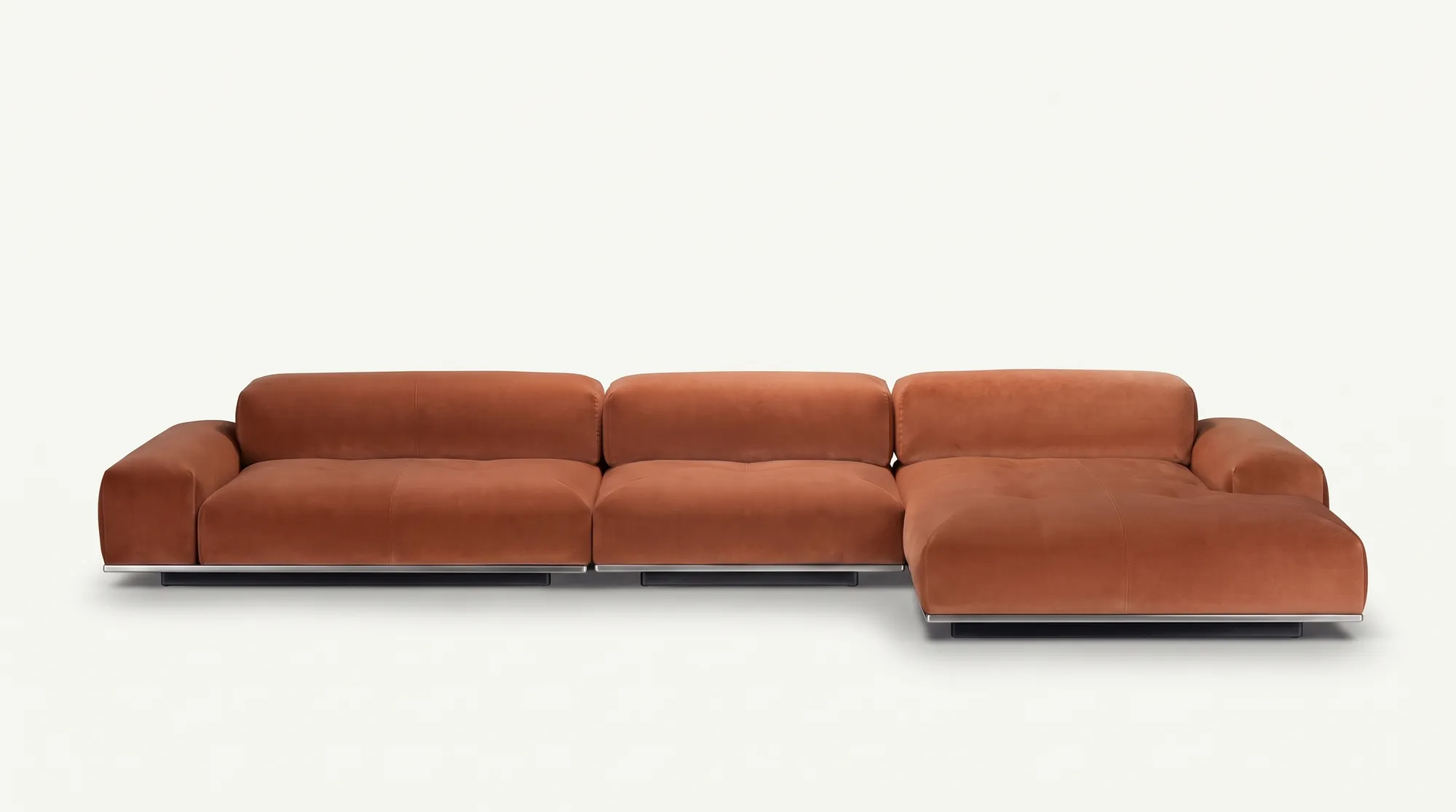
See the ORION sofa in the catalog
Frequently asked questions
How long does checking one frame take?
Between 20 and 40 minutes depending on the model’s size and construction.
Is every unit checked, or only a sample?
Every frame is checked individually — unlike sampling checks on mass production lines.
What happens if a frame fails the check?
The joint is redone on the spot, same shift, same workshop — exactly why the check happens before upholstery.
Which international standards guide the testing?
By principle — approaches described in EN 1728 (seat loading) and EN 1022 (stability), without full lab certification of every unit.
How often does a frame need a joint reworked after the check?
By internal data, roughly one frame in fifteen to twenty, more often on complex non-standard geometries.
Can I see the check record for my own order?
Yes, on request we show the filled-in check record with date and completed items for a specific piece.
Does the frame check protect against damage from misuse?
No — it guarantees no original defect on leaving the workshop, not invulnerability under extreme misuse.
Is stability checked separately for slim-leg armchairs?
Yes — a narrow base is more sensitive to sideways weight shift, so these models get an especially careful stability check.