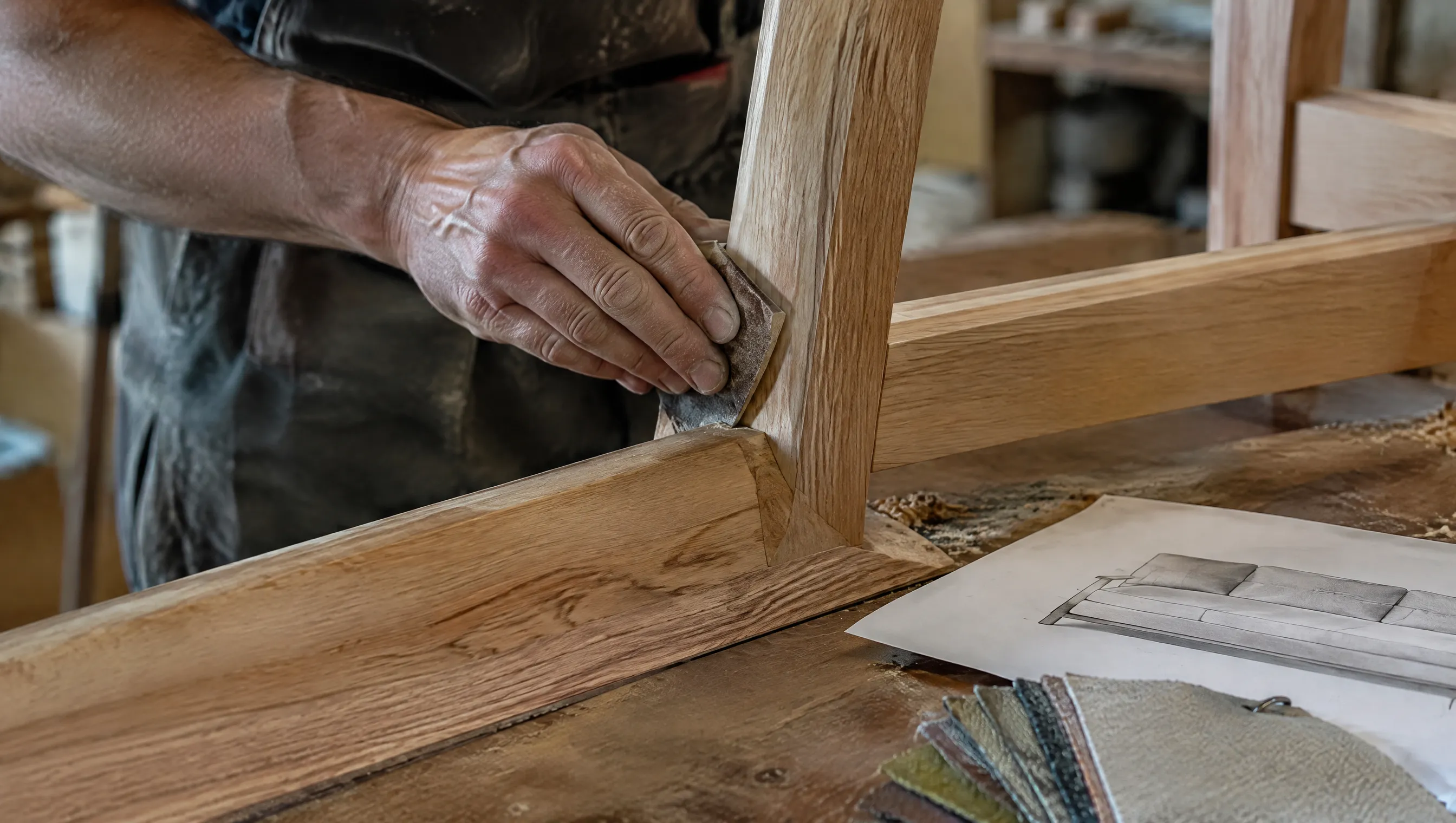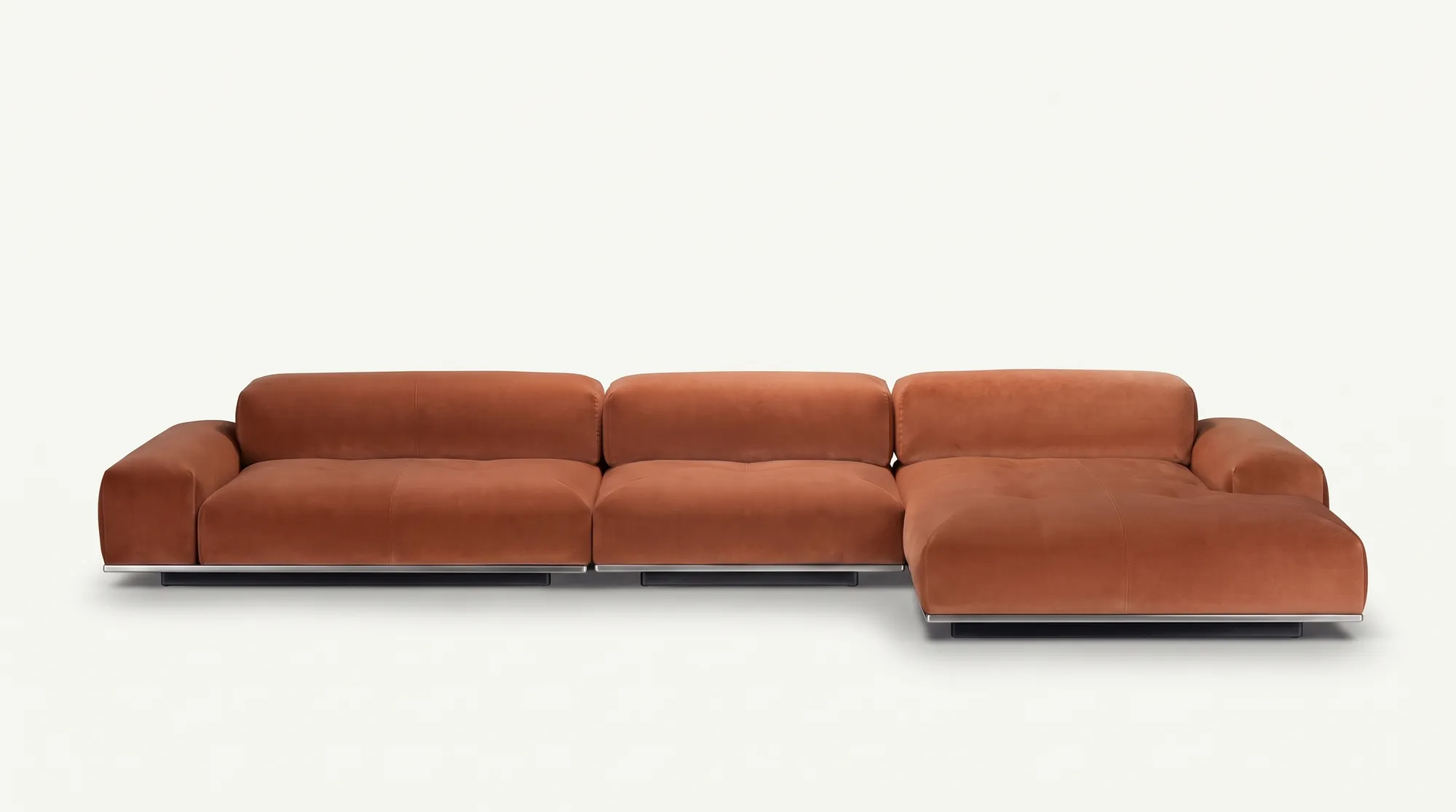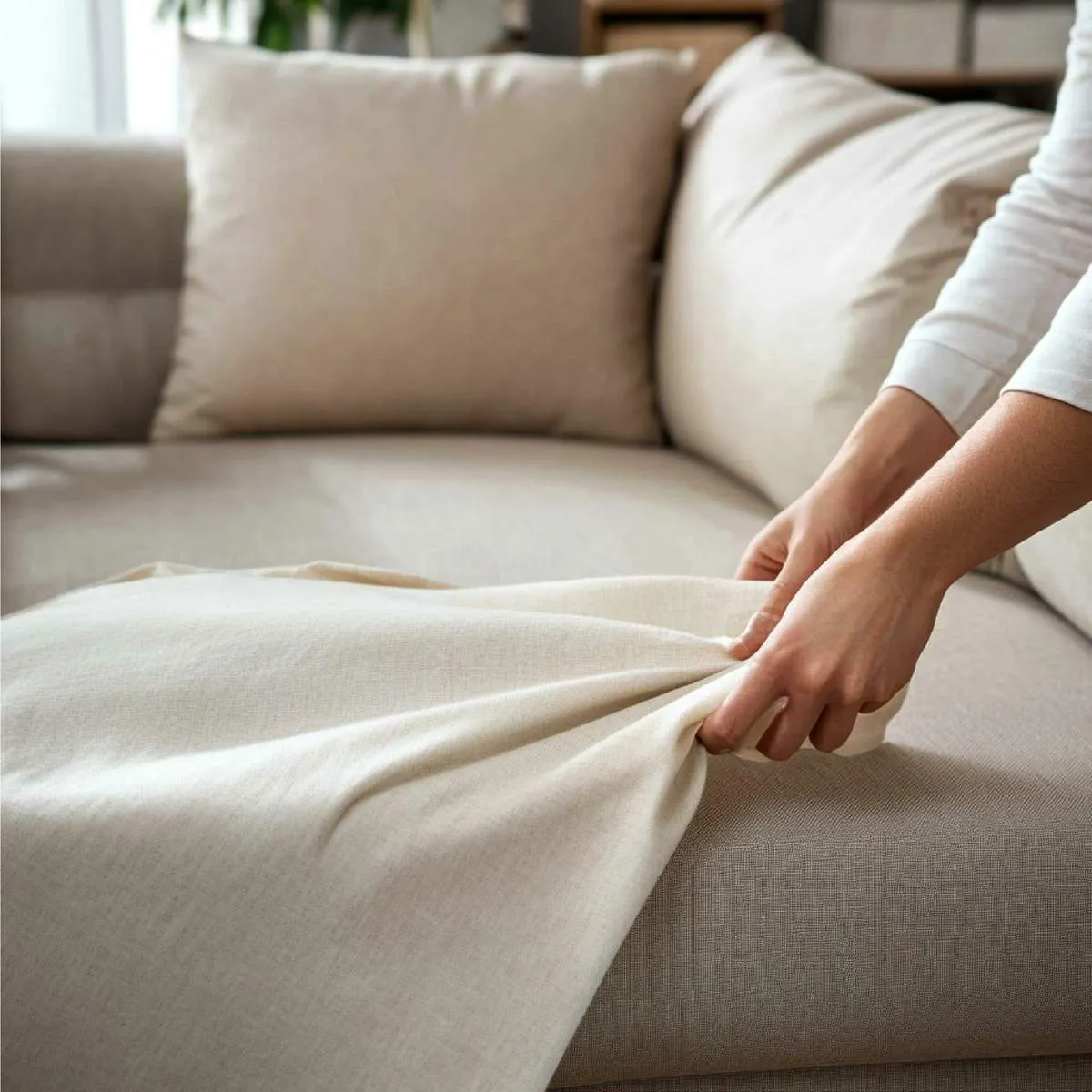
With a professional partner the conversation starts from a drawing and brief, not "recommend a sofa" — and that changes the whole process, from the first meeting to who signs the quote.
How a designer’s brief differs from a retail request
A retail client usually arrives with a problem to solve; a designer arrives with a decision already made at the project level — exact dimensions for a niche, a specific armrest height, a colour matched to the palette. Our job is to execute that requirement, not offer a similar catalog alternative.
This does not mean production has no say — if a drawing implies a structurally weak solution, we are obliged to flag it before starting, not silently execute it and face a complaint a year later.
Adapting a catalog model to the drawing
Most often what goes into production is an adaptation of an existing catalog model — overall size, fabric, sometimes leg height or seat depth — to fit a specific interior and niche. It is faster and cheaper than a full custom design, with almost no visual difference in the result.
A fully new design is needed less often — usually when a designer specifies non-standard geometry the catalog simply does not have, such as a curved bay-window sofa or an asymmetric armchair for a room’s angle.
What happens when a drawing does not match our standard patterns
A designer’s drawing almost never matches internal production patterns exactly — a couple of centimetres’ difference in armrest height is routine. The engineer transfers the drawing’s dimensions into internal documentation, checks them against the material’s structural limits, then releases the cutting.
Timelines for professional orders
The base timeline is the same as retail — 5–8 weeks from an approved sketch. The difference is that professional orders often involve several pieces for one project with different readiness dates, so priority needs agreeing in advance.
- Sketch and dimension approval from the designer’s drawing — 3–7 days, slightly longer than retail
- Frame and filling — 1–3 weeks, unchanged from retail
- Upholstery — 1–2 weeks, longer for a non-standard client-supplied fabric
- A multi-piece project gets a separate schedule per room if deadlines differ
Who pays, and how the order is placed
An order can be placed directly by the client or through the designer’s studio — both are common, depending on how the designer-client contract is structured. If through the studio, it is agreed separately who signs off the final sketch before production starts.
What professional cooperation terms cover
Separate terms for designers and architects are not just a volume discount — a dedicated manager for the whole project, priority on fabric sample approval, a preliminary quote from the sketch before materials are finalised. Specifics depend on the studio’s order volume and regularity.
How responsibility splits between architect and production
If the result does not match expectations, it helps to know the boundary in advance: production is responsible for matching the signed-off drawing exactly; the designer is responsible for whether those parameters suit the room as a whole, since only they see the full interior, not one piece of furniture.
What we check before releasing to production
- Whether the drawing’s dimensions match the material’s real structural tolerances
- Whether a leg or support is thick enough for the stated load, especially under stone tops
- Whether a designer-supplied fabric’s yardage covers the full cut without visible shade variation
- Whether the final sketch is signed by the party contractually entitled to approve it
A note from a KALLEN HOME partners-department manager
"The most common delay on designer projects is not production but the architect-client sketch approval, which can drag on. We try to join as early as possible at the brief stage, to flag structural limits before the drawing is already signed and awkward to change," says a partners-department manager.
By her account, projects where production is involved at the sketch stage rather than after approval finish one to two weeks faster on average — structural questions get resolved once, not reopened on an already-approved drawing.
Working with 3D visualisation and project renders
If a designer sends a 3D render alongside the drawing, material approval goes faster — easier to anchor fabric and frame colour to a visual than describe in words. The caveat: on-screen colour almost always differs from the real room due to monitor calibration and lighting, so final colour confirmation always goes through a physical swatch, however good the render.
A render also helps catch scale errors early — a sofa can look proportionate in the visual while the drawing’s real numbers put the armrest 5–7 cm above the windowsill, invisible on screen but obvious in the room. The engineer checks this separately from the render’s aesthetics, by the drawing’s actual figures.
When a designer works with several contractors at once
On a large project, custom furniture often runs parallel to joinery, wall finishing and lighting installation from other contractors — install order matters. If a built-in niche is not yet finished, delivering upholstery too early risks construction dust or paint contact, so the furniture’s readiness date is agreed against the whole site’s schedule, not just our own.
If contractor schedules do diverge, a finished piece can be held in storage without damage risk — usually at no extra charge if the delay stays within a few weeks.
Warranty and service after the design project is handed over
Warranty terms for furniture made under a design project do not differ from retail — same frame and mechanism coverage, same upholstery terms with proper use. The difference is who reaches out if an issue comes up — the end client or the studio on their behalf — a detail worth fixing in writing upfront, not after a warranty case arises.
A short example from practice
On one project, an architect’s drawing specified a 55 cm armrest — noticeably lower than this model’s standard 65–70 cm. Rather than silently executing it, the engineer called to confirm it was a deliberate choice for a low windowsill, not a documentation typo. It was confirmed and kept — asking first avoided reworking a finished piece.
Fabric samples and remote approval
For Moscow studios, samples usually arrive by courier or are picked up at the showroom, but for projects in other cities approval happens by post: we send a physical sample set rather than relying on photos, since colour and texture never translate accurately even with a good camera. Regional sample delivery, usually 3–5 days, is built into the project schedule as its own line item.
What happens after the project is handed over
After delivery and final acceptance, a project is not simply closed in silence — we typically follow up with the designer or client a few months later to check for usage questions, especially after non-standard choices like a custom fabric or built-in configuration. It is not a tick-box survey but a way to catch a small issue, like a joint creak, while it is still under warranty.
Scale: from one armchair to a whole house
Working with a designer does not have to mean a large multi-piece project — sometimes it is one armchair for a specific niche in an already-finished interior, where an architect gets involved simply because no catalog model fits the size. The process stays the same, just shorter and with lighter paperwork than a whole-house project.
Repeat projects with the same studio
Studios returning for a second or third project usually move through the brief noticeably faster — we already know how that team formulates requirements and which details are critical to them. It is not a formal volume discount but a real speed-up from accumulated context, visible in far fewer clarifying questions the second time around.
What we expect from the designer, and what falls on us
From the designer we expect precise room dimensions and clearly stated priorities on timeline and materials — without that, even an experienced engineer is guessing, not designing. From ourselves we expect to flag structural limits honestly before work starts, not after, and to keep the client informed at each major stage. When both sides hold up their end, a project moves far more predictably.
Takeaway: where a professional partner should start
If a studio is reaching out for the first time, the most effective first step is not sending a finished drawing straight away, but requesting a short fifteen-minute call with the engineer to outline scope and material constraints before the drawing is worked out in detail — saving hours otherwise spent revising an already-signed sketch.
In the end, the difference between an easy and a difficult collaboration with production rarely comes down to studio size or project budget — more often it is about how early both sides started speaking the same technical language, rather than exchanging pretty pictures with no concrete numbers.
For a studio that has not worked with us yet, the easiest way to see this is on one small item — a chair or a table for a specific niche — rather than trusting a whole-house project to an unfamiliar producer straight away. A first small order works as a process-compatibility check before the stakes get higher.
If that first experience goes smoothly, the scale of the next order usually grows on its own, without extra persuasion on our part — trust in this work is built through orders, not presentations.
This is probably the most honest measure of a production partnership’s quality — not nice words about cooperation on a website, but whether a studio comes back for a second order on its own, without reminders from our side.
That is probably the right place to stop — the remaining details of any given collaboration are usually worked out not in a general article but in a conversation about a specific project.
Terms for designers and architects
Frequently asked questions
Does a designer need a separate account to work with KALLEN HOME?
No, cooperation is arranged directly through the partners department, no separate registration needed.
Can furniture be made strictly to the client’s own drawing?
Yes, this is standard practice — the drawing is transferred into technical documentation and checked against structural tolerances before release.
Are there discounts for bulk orders from studios?
Terms for bulk and regular orders are discussed individually with the partners department.
Who is responsible if the furniture does not feel right in the interior?
Production is responsible for matching the signed drawing; how the piece suits the rest of the room is the designer’s responsibility.
At what stage should production be brought in?
As early as possible, at the sketch stage — this resolves structural questions before the drawing is signed and awkward to change.