A guest room used only a few times a year does not need a large furniture set — a comfortable bed, somewhere to put belongings, and a warm light source are enough. What from that minimum is truly necessary, and what can wait.
Why a dedicated guest room still pays off even with rare guests
A room reserved only for guests, in a flat where every square metre costs real money, often looks like a wasteful use of space — especially with guests only two or three times a year. In practice, the alternative — a study or child’s room temporarily cleared for guests — causes more hassle than it saves: work items or toys have to be moved out beforehand and the room restored afterward, a cycle repeating with every visit.
If space genuinely does not allow a room exclusively for guests, the sensible compromise is designing a study or dressing room so a bed or folding mechanism is built in from the start, not bolted on later as an awkward temporary fix. This complicates the room’s layout slightly upfront but fully removes the problem of redoing it for every visit.
The main question before choosing furniture: how often, and who
A guest room for parents staying a week every couple of months and one for friends occasionally crashing after a late dinner are two different technical tasks, even in the same physical room. The first scenario needs a genuinely comfortable bed with a good mattress; the second needs a compact, quickly ready sleeping spot where weeks-long comfort depth is not critical.
The bed: comfort matters more than room size
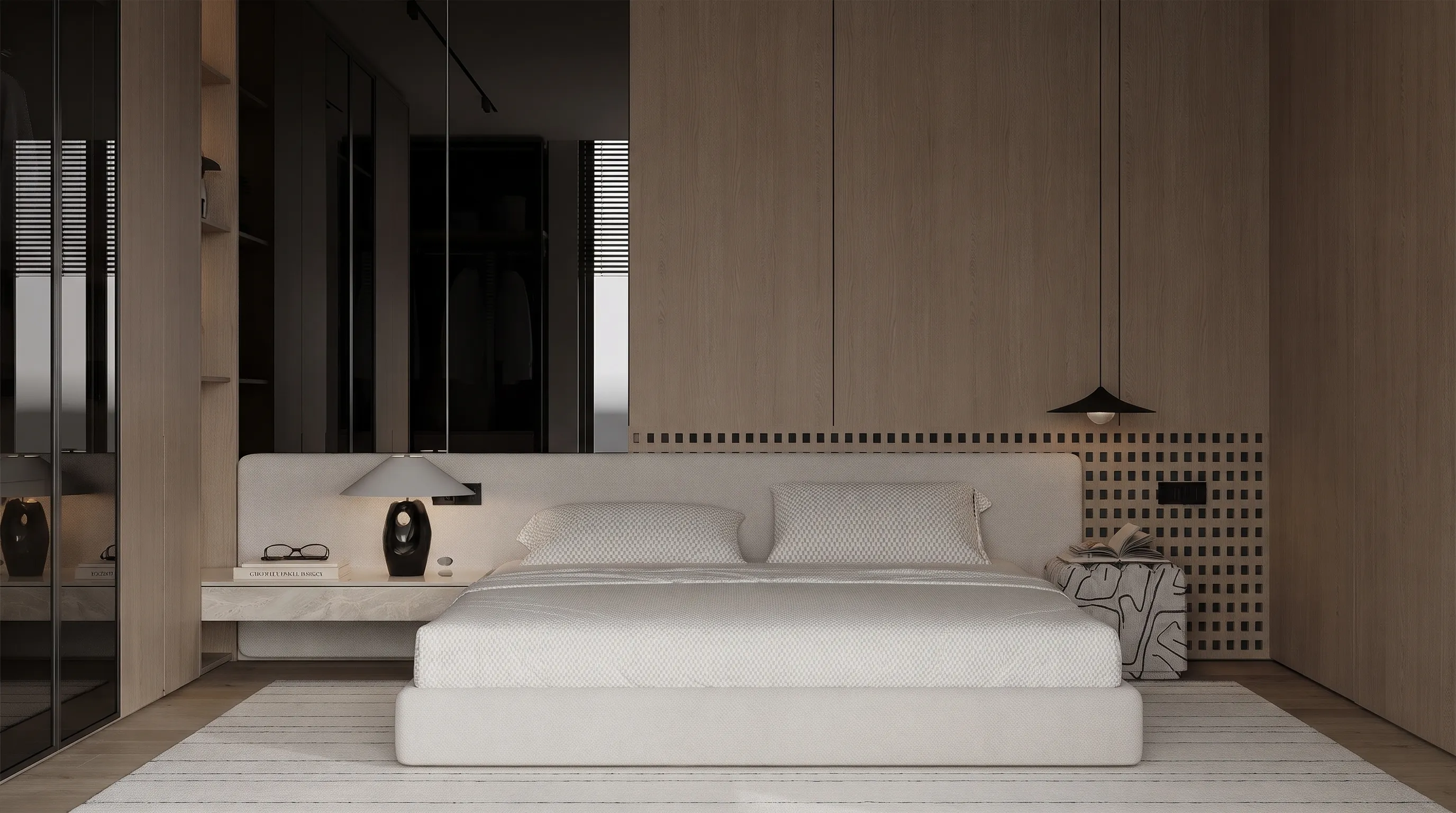
Even in a small guest room, it is worth choosing a bed with a proper mattress rather than a sofa bed — guests feel at home faster on a bed that feels familiar, not on a mechanism that differs noticeably in firmness and geometry overnight. The SOFT model suits such compact rooms thanks to its restrained headboard dimensions, which need no extra side clearance.
The main argument against a sofa bed in a dedicated guest room is not comfort itself but that it almost always needs daily folding if the room doubles for other daytime uses. For a room standing free all year specifically as a guest room, that argument does not apply, and the choice between a bed and a sofa bed then comes down to room size and budget rather than principle.
Bed size: a double is not always necessary
A single or extra-wide single bed, 90–140 cm wide, usually fits comfortably into a room from 8 sqm and covers most real scenarios — one guest, friends visiting separately, a visiting teenage relative. A 160 cm+ double is worth ordering only if the room regularly hosts couples, not "just in case," since the extra 20–30 cm width in a compact room almost always comes at the expense of walkway and space for other furniture.
Furniture layout: walkway matters more than decor
In a small guest room it is tempting to position the bed to free space for a decorative chair or extra shelf — but if that means approaching the bed sideways or squeezing past furniture in the dark, the layout creates discomfort every night of a stay, not just once during a viewing. The rule is simple: first secure a clear 50–60 cm walkway to the bed on both reachable sides, then fit decor into what is left.
Outlets and charging: a small thing that decides guest comfort
Today’s guest almost always arrives with a phone needing an overnight charge, sometimes a laptop or tablet too — and an outlet near the bed, not only by the door, is often missed at the planning stage if the room was not originally meant as a guest room. At least one outlet within arm’s reach of the headboard solves this completely and costs almost nothing if planned at the wiring stage rather than after.
The mattress: the one line item not worth cutting
A guest room is exactly where it is tempting to put the cheapest mattress "since guests are rare." That logic backfires — a guest sleeps on an unfamiliar bed in an unfamiliar room, and a hard or sagging mattress feels worse there than at home, where years of habit smooth things over. A sensible compromise is a mid-range mattress with neutral firmness that suits most people, not the cheapest or the priciest option.
A place for belongings — a surface, not a wardrobe
A guest staying for a weekend often does not need a whole wardrobe — a chair or bench for a suitcase and a bedside surface for phone, glasses, a book are enough. A full wardrobe in a guest room more often stands empty all year, occupying floor space that could go to more useful furniture, or simply stay open.
- A bench with a linen drawer — doubles as suitcase space and light storage
- A chair or pouf by the bed — enough for clothes over one or two nights
- A single-shelf bedside table — enough for a phone, glasses, a glass of water
- A full-length mirror on the door or wall — rarely planned for, but guests almost always look for one
Light — warm and adjustable
A bedside lamp with warm, dimmable light solves two problems at once: comfortable reading before sleep, and no glare if a guest gets up at night in an unfamiliar room, where it is harder to navigate in the dark than at home. A bright overhead light alone is not the best solution for this room — handy for cleaning, but uncomfortable for the guest’s own evening use.
It is also worth placing a switch reachable right from the bed, not only by the door — a detail owners rarely think about in their own bedroom, where the layout is familiar, but one that becomes a real inconvenience for someone seeing the room in the dark for the first time.
Bedding and textiles: a separate set, not shared with the main bedroom
Owners often save time by sharing bedding stock between the guest room and the rest of the house, pulling a set from the same cupboard the night before guests arrive. It is more convenient to keep a separate, permanently ready set for the guest room — at least two full bedding sets and two towels per bed, so nothing has to be washed and dried in a rush when guests announce a visit a day or two ahead.
It makes sense to store that separate set right in the guest room itself, in the same bench drawer already handling suitcase storage — bedding then needs no space in the shared wardrobe, and preparing the room before a visit is just making the bed, not hunting the flat for a set.
A children’s guest room: a special case with extra requirements
If the guest room is periodically used by grandchildren or friends’ kids, the requirements expand — bed rails for very young children, stable rather than narrow bedside furniture with no sharp corners, and a genuinely soft, non-glaring night light instead of an ordinary bedside lamp. These details are rarely planned in advance when a room is designed with only adult guests in mind, then get bought in a rush before a specific visit.
Smell and airing: a detail forgotten until the last moment
A room standing closed and unventilated for months develops a characteristic stale smell that owners stop noticing while living alongside it, but a newcomer registers instantly on walking in. Airing the guest room at least once a week, even unused, is a simple habit that solves this completely and needs no furniture or budget at all.
The same logic applies to bedding sitting folded in a cupboard unused for a long time — even a freshly ironed set gradually absorbs the cupboard’s own smell, and it is worth airing or remaking it every month or two, not only right before guests arrive.
What you can skip buying entirely
A TV, a separate desk, a reading chair — items that feel like logical additions to a "proper" room, but in a guest room used only a few times a year almost never justify their cost and footprint. If a guest really wants to work or watch something, a laptop on the bedside table or in bed is usually enough — dedicated furniture for that is overkill in a guest room.
A separate "just in case" second sleeping spot — a folding cot or an air mattress in a closet — follows different logic. If guests genuinely sometimes arrive in a larger group, it is more sensible to order one proper, if compact, extra sofa bed or folding bench for a neighbouring room once than to keep a stopgap solution in a cupboard that turns a night’s stay into an ordeal for whoever draws it.
Decorative cushions and a throw beyond the bare minimum are also more a matter of the owners’ taste than a real guest need — most guests simply move them to the floor or aside the moment they go to sleep, so spending a large share of the room’s budget on them is not essential.
Seasonal items and temporary storage: the guest room’s second life
A room standing free most of the year sensibly doubles as temporary storage — suitcases, seasonal items, skis or a bike in winter can live here, if the bench and under-bed space are designed with that in mind from the start. The key condition is that storage must clear in one pass before guests arrive, not require digging through clutter, or the room effectively becomes a storeroom that only occasionally turns into a guest room, rather than the other way round.
A note from a KALLEN HOME designer
"The most common redo we get asked for in guest rooms a year or two later is removing an unnecessary wardrobe and adding a bench with a drawer instead. Clients initially furnish the guest room in full, as if for a permanent resident, then see that only the bed and one nearby surface actually get used," says a KALLEN HOME designer.
Her advice is to start with the minimal set described above and build the room up only once it becomes clear how often and exactly how it is actually used over a year, rather than designing it from day one as if guests would live there permanently.
The resulting minimal guest-room set, which almost always proves sufficient: a bed with a good mattress, a bench or chair for belongings, a bedside table with a lamp and an outlet within arm’s reach, and a separate bedding set that need not be hunted for across the flat before guests arrive.
Everything else — a TV, a desk, a spare second sleeping spot — is best added only once an actual need appears, not "just in case" in advance: unlike the owners’ own bedroom, a guest room is easy to fine-tune for a specific family of guests after the first visit or two, once it is clear what they actually need.
If guests are expected for the first time over a long holiday
Before hosting guests for several days running rather than one night, it is worth checking details that do not surface on short, rare visits — whether the curtain blocks morning light well enough for comfortable sleep, whether the window or door draughts in cold weather, and whether there are enough hooks or hangers for a week’s clothes, not just one night’s change.
A mirror and an outlet: two details almost always forgotten
A full-length mirror and a nearby outlet for a hairdryer or phone charger feel minor next to a bed and wardrobe, but their absence is what most often causes a guest’s first-morning inconvenience — hunting for a mirror in the hallway or dragging a cable across the room. A mirror can hang inside a bench or wardrobe door if wall space runs short, and a guest-room outlet is worth planning during renovation, not patched with an extension cord before every visit.
See the SOFT bed in the catalog
Frequently asked questions
Should a sofa bed be chosen instead of a bed?
If the room is used only as a guest room and stands free most of the year, a proper bed is more comfortable; a sofa bed makes sense only if the room serves another purpose by day.
What bed size is optimal for a small guest room?
A single or extra-wide single bed, 90–140 cm wide, usually fits comfortably into a room from 8 sqm and covers most scenarios.
Is a separate storage system needed for a guest room?
Not necessarily — a bench with a linen drawer often solves the problem more compactly than a full wardrobe, which usually stands empty.
Is it worth saving money on the guest bed’s mattress?
No — unfamiliar surroundings already reduce sleep comfort, and a hard or sagging mattress makes it worse; a mid-range, neutral-firmness mattress is the sensible choice.
Does a guest room need a TV or a desk?
Usually not — a laptop on the bedside table is enough for occasional use, and dedicated furniture for this almost always stands idle.
What to add if children sometimes stay in the guest room?
Bed rails for young children, stable furniture with no sharp corners, and a soft night light instead of an ordinary bedside lamp.