Hosting 15–20 people in a flat built for four does not need new furniture — it needs a temporary layout, easy to set up before the party and fold back the next day.
Three typical evening scenarios, three different layout approaches
A family dinner for 8–10, a party for colleagues with 20+, and a children’s morning the next day each need different layout logic even in the same flat on the same weekend. A family dinner needs one big table and good overhead light; a 20+ party needs clear walkways and mobile drink points throughout the flat; a children’s event needs low, stable, corner-free furniture and open floor for play, not seat count at all.
The sensible practice is deciding in advance which scenario is primary for a given day and laying out furniture for that one, rather than trying to cover all three events back to back with one universal scheme and no reset in between.
The main mistake: counting seats, not the evening’s scenario
The first instinct before a party is to count guests and provide exactly that many seats. In practice, not everyone sits at once at a New Year’s party — some stand by the table, some move between rooms, some help out or chat in the kitchen — so a sensible seat count usually runs 30–40% below the guest count, not equal to it, for an evening built around free movement rather than a formal seated banquet.
Poufs and benches as temporary extra seating
A light pouf is easy to carry between rooms and put away right after the party — more convenient than folding chairs that rarely match the interior and sit in a cupboard the rest of the year. For a group of several guests, it makes sense to keep two or three such poufs at home year-round, not buy them specially before each holiday.
A storage bench solves two problems at once — extra seating for the evening and a place to stash throws or cushions removed from the sofa to free up more sitting room. This double function makes a bench more practical than an ordinary chair, especially in flats short on storage.
Clear the perimeter and walkways, not the room’s centre
For an evening with many guests, it is more comfortable to push large furniture toward the walls, leaving a clear path through the centre and, crucially, between rooms — these are the routes people use most: living room to table, table to hallway, hallway to bathroom. A sofa normally centred in a room can be pushed to a wall for one evening, even losing its usual coffee-table arrangement — for one night, walkability wins over aesthetics.
- Passage between rooms — at least 70–80 cm even with furniture temporarily shifted
- The table-to-kitchen route — clear this first, it sees the most foot traffic all evening
- The entryway zone — coats and shoes pile up here, worth a dedicated spot planned in advance
- Outlet access for food warmers or a speaker — do not block it with furniture; harder to move mid-party
Standing guests also need a place for things, not just a seat
A guest spending the evening standing or moving between rooms still needs somewhere to set down a glass, plate or phone — without such a surface where most guests gather, people start resting things on sofa armrests or the floor, risking both the furniture and the drink. The sensible fix is adding one or two low side surfaces exactly where a crowd tends to form, like near the kitchen entrance.
A children’s zone: a separate island, not a shared corner
If children are among the guests, it is better to set aside a small separate island with a low table and floor cushions than to assume they will sit at the main table all evening. Placing this island in the room adults use least that particular evening keeps children’s activity from crossing the main guest flow and crowding the walkways.
A cloakroom for the evening: plan before the first guest arrives
For 15–20 guests, a normal entryway is almost never built to hold everyone’s coats and shoes at once — worth setting aside a separate room, or part of a bedroom, as an evening cloakroom, with a portable coat rack and a mat protecting the floor from water and dirt. Not an aesthetic choice, a purely functional one — without it the entryway overflows within the first twenty minutes.
The dining table: extend it, do not replace it
If the usual table seats four to six and more guests are expected, it makes more sense to temporarily extend it with a leaf or a side table of matching height than to buy a separate banquet table used once a year. A 1–2 cm height gap between the main and side table is usually not visually critical, but worth checking in advance, not on the day itself when it is harder to fix.
A prep timeline: when to start rearranging
It makes sense to start moving large furniture the evening before, not on the day itself — leaving time to notice a walkway still too narrow and fix it without rushing. The day of the party should hold only light final touches — arranging cushions, lighting candles, laying out snacks — not dragging a sofa around in the last hour before the first guest arrives.
Light and zoning without moving walls
Where guests cannot be physically split across rooms, light does the zoning — a bright zone by the table signals "eat here," dimmer light by the sofa signals "talk here." A portable lamp or string lights reshape a room’s perceived boundaries more effectively than trying to physically divide space with furniture that has nowhere to go anyway.
A speaker and its cables: a separate planning item
A portable speaker almost always ends up the evening’s focal point, but its power cable rarely gets planned ahead — it ends up running across the busiest walkway and becomes a tripping hazard faster than any furniture. It makes sense to place the speaker by a wall near an outlet rather than room centre, even if the centre sounds acoustically a touch better — walkway safety matters more than perfect sound for one evening.
If the home has several floors or levels
In multi-level homes, it is worth deciding in advance which floor is the main hosting level and which is secondary, rather than letting guests spread chaotically through the whole house. The main floor gets the reinforced furniture layout; the secondary floor gets just enough for guests wanting quiet, not built for the same crowd at once.
A balcony or terrace as an extra zone, not a backup
Weather and the room permitting, a balcony or glazed terrace can take some load off for one evening — a spot for guests who smoke, or a quiet corner for a two-person chat, without overloading the main rooms. A couple of folding chairs or that same light pouf moved there for the night is enough, not dedicated furniture standing idle there the rest of the year.
What to agree with guests in advance so the layout works
Furniture layout does not solve everything — part of the load lifts with a simple agreement with close friends who arrive early, asking them to help seat people and point newcomers to free spots. A host personally greeting and seating every single guest all evening simply cannot also watch whether someone is about to rest a plate on a delicate sofa armrest.
Put everything back without rushing or losing track
Photograph the layout on your phone before rearranging — saves time afterward and removes the need to recall where everything stood, especially when several rooms change at once and details like the sofa’s exact distance from the wall are easy to forget by the next day.
It is better not to undo the temporary layout the very morning of January 1st, but a day or two later, once the urge to heave furniture around while exhausted has passed — an extra day changes nothing, while a rushed, tired rearrangement sometimes ends in a scratched floor or a tripped-over rug.
What to do with rugs under heavy guest traffic
A rug that normally sits loose under a coffee table can become a tripping risk on a busy evening as its edge curls under frequent, fast foot traffic. For such evenings it makes sense to either temporarily fix the edge with rug tape, or remove the rug for the night and return it afterward with the rest of the furniture.
Protecting upholstery for one evening
A sofa and armchairs that normally see one or two cups of tea face noticeably more risk at a New Year’s party — wine, sauces, candles near fabric. A simple measure needing no reupholstery is removing the lightest, most stain-visible decorative cushions beforehand and swapping in darker ones, or ones that matter less if marked for one evening.
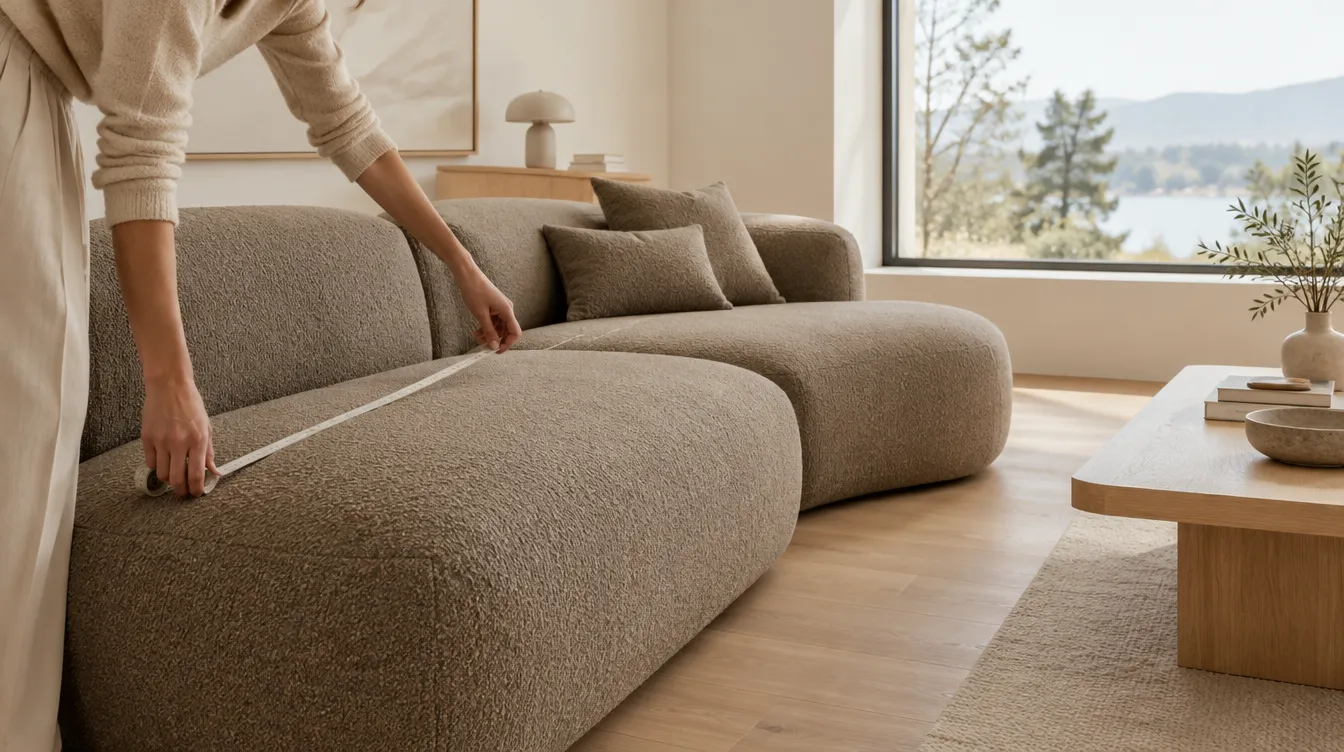
For especially delicate fabrics like bouclé or pale velvet, the seat area specifically can be covered for one evening with a thin, neutral-toned throw — barely noticeable in warm evening-light photos, but removing most of the risk to the upholstery’s priciest, hardest-to-clean part.
A note from a KALLEN HOME designer
"The most common pre-New-Year request is 'how do I seat twenty people in a flat built for four.' We always answer the same way: do not seat everyone at once — let people stand, move and take turns sitting, which is exactly why poufs and benches beat fixed chairs here," says a KALLEN HOME designer.
By her account, the second most common request is making the rearrangement not look like a rearrangement — part of the evening’s natural decor. That means choosing poufs and benches in fabrics matching the room’s other textiles ahead of time, not grabbing the first temporary fix on hand, which would stand out awkwardly in the evening’s photos.
She also advises against expecting a perfect layout on the first try — a finished party is the best chance to notice which zone felt cramped or stood empty all evening, and adjust exactly that spot next time rather than redesigning everything from scratch.
A short summary: three principles instead of a shopping list
Boiled down, three things matter: count real simultaneous seats, not guest headcount; clear movement routes before decorating; and keep a couple of universal mobile pieces — a pouf, a bench, a folding table — ready in advance, rather than buying furniture for one specific party that then sits idle all year.
If guests are expected over several evenings, not just one
The New Year holidays often bring not one gathering but several in a row, with different company each time. In that case it makes more sense to keep the layout in its "party" configuration through the whole break, fine-tuning details per evening — more chairs for a family dinner, more open floor for a casual evening with friends — rather than rebuilding it from scratch each time.
A kids’ corner at a party with children
If children are among the guests, a separate low table with their own chairs or floor cushions, away from the main table, solves two problems at once — adults stop worrying about plates near expensive upholstery, and children get their own zone without having to share the adult company. That table can be improvised from the same mobile pouf and a tray, with no need to buy dedicated kids’ furniture for one evening a year.
See the LAGO pouf in the catalog
Frequently asked questions
How many seats are needed for a party of 20?
Usually 12–14 seats are enough if the evening allows free movement rather than seating everyone formally at once.
Will frequent rearranging damage the furniture?
No, if moved carefully without dragging large pieces across the floor — use felt pads under the legs.
What if a rug makes it hard to move furniture or risks curling?
For the party, the rug can be rolled up, swapped for a smaller one, or its edge fixed with rug tape.
How many poufs is it sensible to keep at home for such occasions?
Two or three light poufs kept year-round usually cover most scenarios without buying furniture before every holiday.
When is the best time to undo the temporary layout after the party?
A day or two later, not right the next morning — fatigue raises the risk of damaging the floor or furniture during a rushed rearrangement.