For a country house, looks matter less than removable covers, humidity resistance, and a frame that will not warp without winter heating.
A country house runs on different humidity rules than a flat
A city flat keeps humidity fairly predictable year-round; an unheated dacha swings from 80–85% in damp autumn weather to near-freezing dry air in winter — stress a city sofa never faces.
These swings, more than dirt or wear, are what ages dacha furniture early — wood and glued joints react slowly but cumulatively.
A material mistake in a flat just means the sofa looks a little worse in five years; the same mistake at a dacha often means a structural repair within two or three seasons.
The frame: why solid wood alone loses to a combined build
Solid wood swells unevenly along versus across the grain, stressing joints; cross-layered birch plywood expands evenly and resists cracking far better.
A combined frame uses solid wood for rigid joints and plywood for large flat panels — far more stable than solid wood alone under seasonal swings.
Removable covers: what to check beyond the fact that they come off
Not all "removable covers" are equal — full zip-off, section-by-section, or only partially removable all mean very different cleaning convenience.
- Does the cover come off without dismantling the frame
- Machine-washable, or dry-clean only
- Are spare covers sold separately
- Does the fabric keep its fit after 10–15 washes
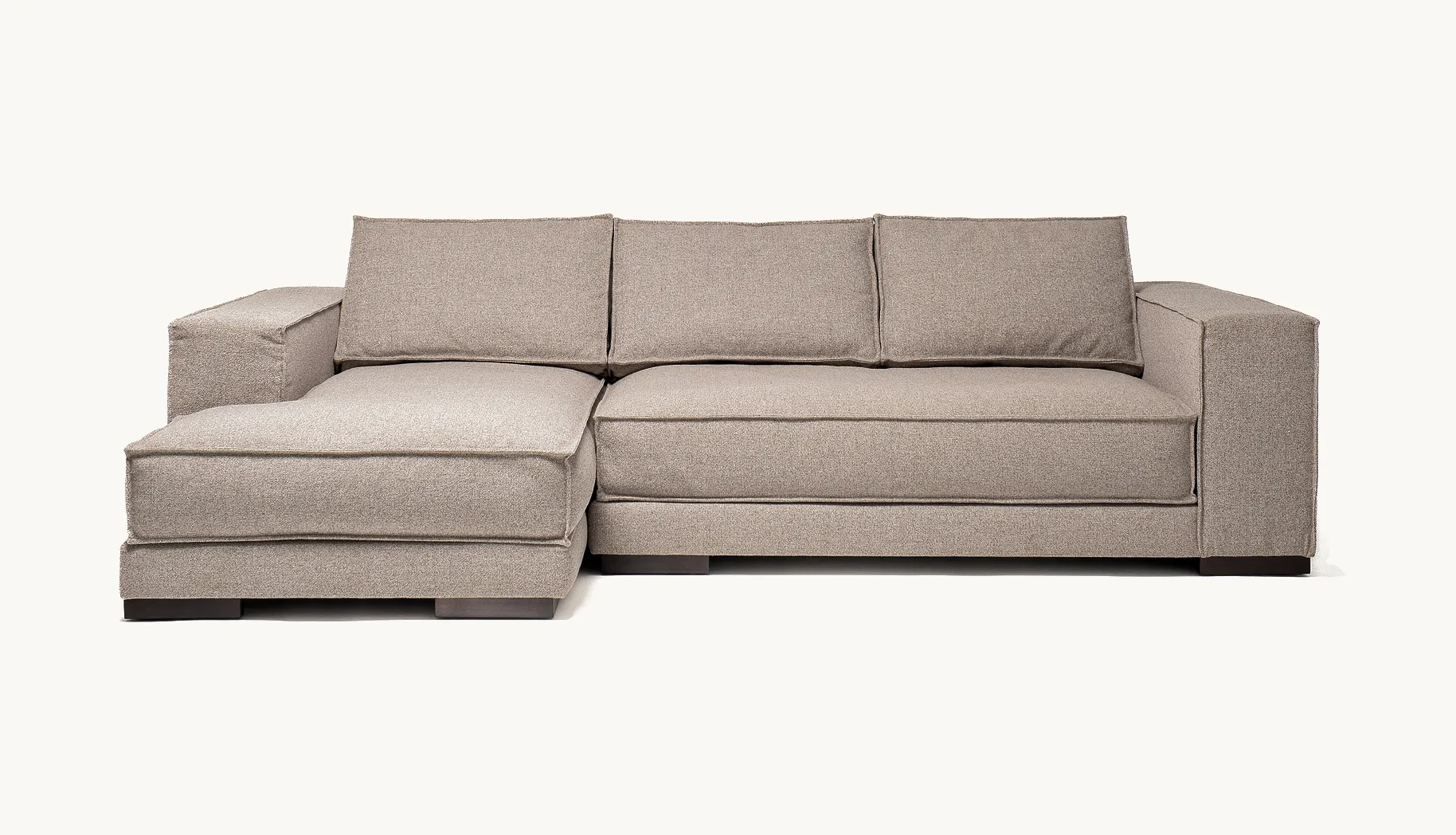
The MIAMI model uses section-by-section covers removable via a hidden zip — a ten-minute job, not a half-day service call.
Fabric: why 40,000 cycles is a calculated need, not a margin for luck
A dacha sofa sees far more hours of use per day than a city one, so the same "30,000 cycles for daily use" rule recalculates to 40,000+ for a summer house.
Frequent washing also mechanically wears the fibre, so fabric meant for biweekly washing needs a higher starting durability margin.
Checking the real figure is simple: ask for a test report for the specific batch, not the collection as a whole — the same rule as for a city sofa, just with a higher threshold in mind.
Legs: metal versus wood on an unstable floor
Floors near the slab see sharper humidity swings than seat height, so wooden legs can swell slightly at the base over a few seasons.
Powder-coated metal legs stay geometrically stable regardless of humidity — a technical choice for unstable floors, not just an aesthetic one.
If the house is unheated in winter: leaving a sofa unattended for months
- Cover with breathable cotton, not plastic sheeting — plastic traps condensation
- Leave a small air gap under the cover
- Keep a minimal positive temperature indoors in winter if possible
- Let the sofa warm to room temperature before first spring use
Filling: why foam copes with damp better than natural down
Natural down absorbs humidity and can harbour mould in a damp interseason house; multi-density foam resists moisture and is the safer dacha choice.
A soft low-density foam top layer over a firmer base gives a similar feel to down with far better moisture resistance.
Which fabrics are actually ordered most for a country sofa
Country orders most often go for blended herringbone cloth, water-repellent acrylic, or dense cotton twill — all three survive frequent machine washing without losing shape or colour.
- Blended herringbone (30–50% polyester) — balanced price, durability, look
- Water- and dirt-repellent acrylic — best for a veranda or sunny side
- Dense cotton twill — natural feel, needs treatment for humidity
- Pure linen and fine bouclé are usually not recommended for dacha use
Delivery and assembly in the countryside: easy-to-miss details
City delivery assumes an elevator and wide entrance; a country house often has narrow gates or stairs, so a modular sofa that splits into sections carries through doorways far more reliably than a one-piece body.
Sharing exact doorway widths and staircase turns in advance takes one phone call and avoids a wasted delivery trip.
Seasonal road conditions matter too — a dirt road fine in dry weather can block delivery after a week of rain, worth flagging before, not on delivery day.
Budget: what is safe to save on, and what is not
The city-vs-country price gap comes from three line items — fabric durability, cover construction, leg type — not frame material; cutting any of them for price shortens the sofa’s life from a decade to a couple of seasons.
It is sensible to save on decorative finish and complex shapes — they matter less day to day at a dacha and can account for 15–20% of a quote.
Service logistics matter too — a repair call-out to a country house costs more and takes longer than in the city, so it is worth clarifying in advance which fixes are DIY and which need a technician.
Most of these questions are settled in one message to a manager before the sketch is approved — the key is settling them before, not after, building to default city specs.
A seasonal summer house and a year-round country home are different briefs
A summer-only house can skip costly cold-resistance features; a heated year-round country home performs like a city one and should be chosen by the usual fabric/filling/configuration criteria.
A house heated only on weekends sits between the two cases and stresses joints more like a dacha than a city flat, even if it stays above freezing most of the time.
A short pre-order checklist
Before approving the final sketch, these five points are the ones most often discussed too late.
- Any winter heating, even minimal
- Typical interseason humidity — dry or damp
- Floor base: slab, dry screed, or ground joists
- Modularity needed for narrow doorways or stairs
- How often covers will realistically be washed
Comment from a KALLEN HOME workshop craftsman
"For country orders we almost always recommend metal legs, and we always ask whether the house gets any winter heating — it changes the frame and filling advice more than the fabric choice," says the workshop team.
Most warranty cases trace back to orders configured on a standard city template without first checking the house’s real heating conditions — a short conversation up front is the cheapest insurance available.
See the MIAMI sofa in the catalog
Frequently asked questions
Can a sofa stay on a glazed veranda for the winter?
Yes, if the veranda is protected from precipitation; use a breathable winter cover and ventilation, not sealed plastic.
How much does it cost to replace a worn cover?
The cost depends on the model and fabric and is quoted individually through KALLEN HOME service.
Does velvet suit a country-house sofa?
Velvet looks richer but copes less well with humidity — a dense fabric rated 40,000+ cycles is usually the more practical choice.
How much more do metal legs cost?
The leg-material price difference is usually small relative to the whole quote — floor and humidity conditions decide the choice, not cost.
Is a modular sofa needed if the staircase is a normal one?
Not always — modularity pays off mainly with narrow doorways, tight stairwells, or unpaved access roads.
Why does foam filling beat down for a country house?
Foam barely absorbs moisture into its structure and does not harbour mould in damp interseason conditions, unlike natural down and feather.