For the summer house season, a living room is easier to adapt with light fabrics and mobile pieces than by buying new furniture — what to change, in what order, and what to leave alone entirely.
Seasonal adaptation changes a layer, not the furniture
The main mistake in prepping a living room for summer is treating it like a mini-renovation needing big new purchases. In practice a room has two layers — the fixed frame (sofa, chairs, table) and the movable layer around it (textiles, cushions, poufs, stands). The season changes the second layer; the first stays put for years unless there is a separate technical reason to touch it.
The same logic works in reverse: a house used seasonally — moved into in May, closed up in September — benefits from being able to pack the entire movable layer into one trip rather than buying pieces of it through the summer. A list of textiles, one pouf and a couple of stands fits in one car, unlike a new sofa that needs separate delivery scheduled with the workshop in advance.
Light textiles instead of heavy ones
For summer it makes sense to swap heavy winter covers for lighter textiles — the room feels visually and physically cooler, without reworking the furniture itself. Cotton and linen blends at 150–220 gsm breathe noticeably better than dense winter velvet or wool, which work well in winter for the opposite property — trapping warmth.
The difference is not just temperature — a light summer cover is also easier to remove and wash, since dacha furniture gets dirtier faster from children, outdoor shoes and pets than city furniture under more predictable use.
A pouf as portable seating
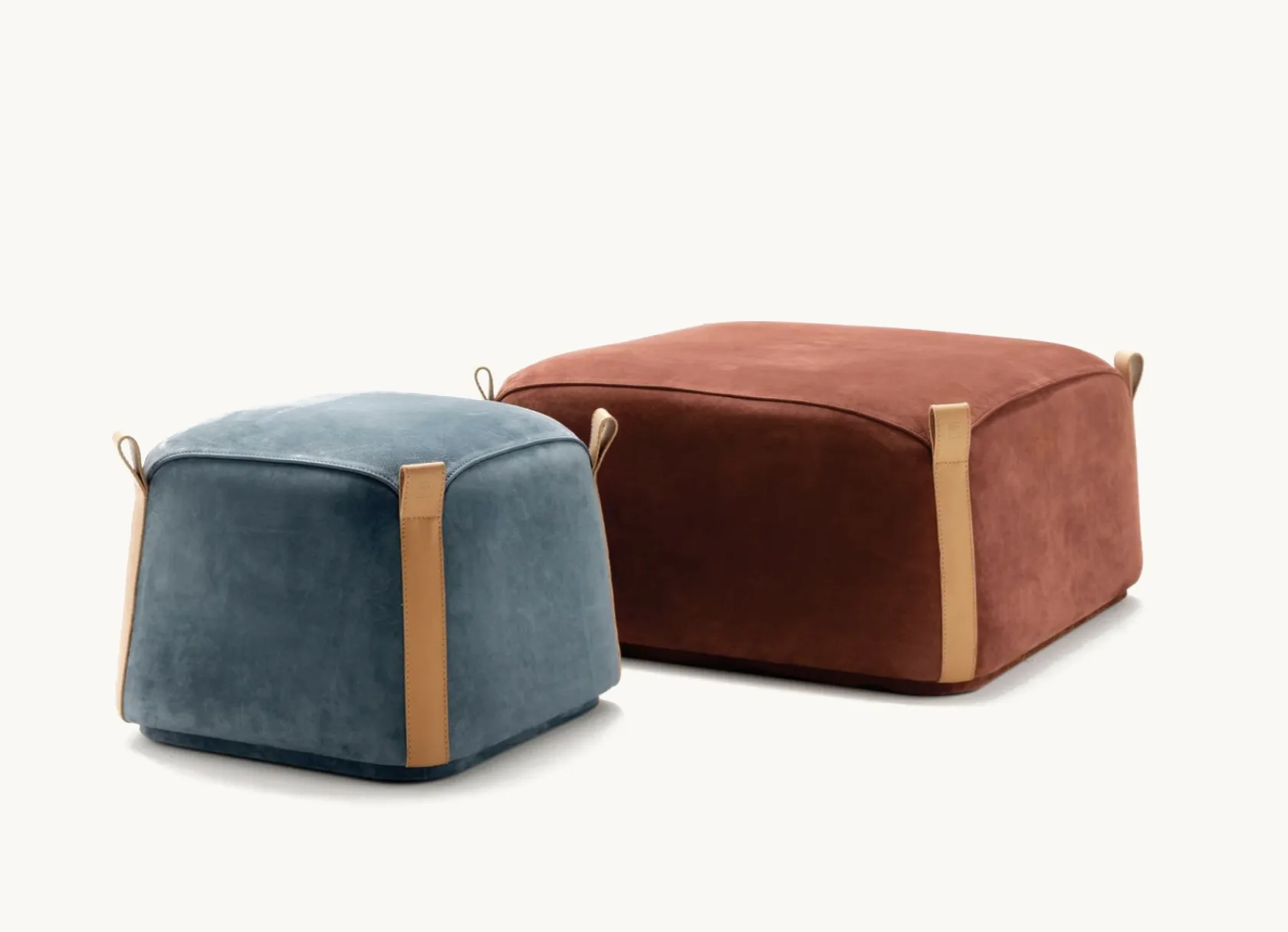
A light pouf is the easiest piece to carry between the living room and terrace through the day — extra seating wherever needed right now, unlike a framed sofa fixed to one spot. What matters for this role is not just weight but base stability: a pouf easily tipped over becomes a hazard, not a convenience, on an uneven terrace floor.
Stands and small tables: the second most useful mobile category
After the pouf, the second most useful summer category is lightweight side tables and stands that can move to whichever chair or lounger the group gathers around. Unlike a fixed coffee table, such a stand does not dictate the rest of the layout — it adapts to it on the spot.
- A light slipcover for sofa and chairs — cotton or linen blend at 150–220 gsm, easy to remove for washing
- A pouf with a stable base — for moving between living room and terrace through the day
- A side table or stand — adapts to wherever the group is sitting right now
- A light-toned throw or cushions — visually "cool" the room without reupholstering the sofa
What to leave as is
The main sofa and framed furniture should stay untouched — seasonal adaptation works through the light, movable pieces around it, not by reworking the interior’s load-bearing parts. A solid-wood-and-plywood frame works equally well winter and summer given normal humidity; dacha-typical humidity swings are solved by frame construction at the ordering stage, not by annually reworking furniture already built.
Which fabric survives frequent summer washing
A summer cover gets washed noticeably more often than a winter one — sometimes every week or two, especially with children or a dog that sits straight on the sofa after a walk. What matters for that frequency is not decorative texture but yarn composition and density: pure cotton at 180+ gsm and a 30–40% cotton-linen blend survive dozens of wash cycles without visibly losing shape, while delicate textured weaves lose definition faster under frequent washing.
It is worth checking separately whether a specific fabric shrinks after a delicate machine wash — better to test this on one cover at the start of the season than discover shrinkage across the whole set in July, when re-sewing is the last thing anyone wants.
Light and colour in a summer living room
Days are longer in summer and direct light enters at a different angle than in winter — dark, saturated textiles that feel cosy on a winter evening can look heavy in bright summer daylight. Lighter, diluted tones visually lighten the room for the season without a single large purchase — a few textile swaps are enough.
What not to do just for the sake of it
A common mistake chasing a "dacha mood" is stripping all textile out of the room, leaving bare chair and sofa frames. The result usually reads not as lightness but as an unfinished renovation — seasonal adaptation works by swapping the textile layer for a lighter one, not removing it. A second common overcorrection is buying a whole new terrace furniture set when one mobile pouf and a couple of light covers for existing chairs would have been enough.
Sun and the terrace: a separate risk, unrelated to indoor fabric
If light furniture gets moved to an open, uncovered terrace, ask the workshop separately whether that specific fabric resists UV and outdoor humidity swings — a different requirement set than indoor living-room textile, and ordinary cotton upholstery will not suit outdoor use regardless of weight.
A separate trap is bringing a pouf or chair in from outside while still damp from dew or rain — even weather-resistant fabric, brought wet into a closed unventilated room, can trap a musty smell inside the frame if the moisture has not fully gone. A sensible habit is leaving anything brought in from outside in a ventilated spot for a couple of hours before putting it back in its usual place.
Modular and transforming solutions for a dacha living room
A separate category working especially well for a dacha is modular sofas and transforming poufs — expandable into a larger set-up for weekend guests, compact on weekdays when only the owners are home. In a city this flexibility is often excess; at a dacha, where the guest list shifts week to week more than in a city flat, it becomes a practical rather than decorative feature.
Storing terrace items between visits
For a dacha not visited every week, a separate question is where to store light mobile furniture between visits if the house is unheated and not always secured in winter. Upholstered poufs and stands are better brought inside for winter rather than left on a glazed but unheated veranda — the temperature swing there is still far wider than in living rooms, and filling loses resilience faster under less stable storage.
When a dacha living room does need the fixed layer changed
There are cases where seasonal prep is not enough and a sofa or chair genuinely needs replacing: the frame has loosened enough to be audible on sitting down, the filling compresses and does not recover overnight, or the configuration no longer matches how the family actually uses the house — say, the usual guest group has grown past what the existing seating count can hold, no matter how the textile around it is arranged. At that point the conversation is no longer seasonal prep but rethinking the furniture itself, better taken straight to the workshop than masked with a new cover.
Insects and odours: a summer specific winter does not have
Open windows and terrace doors in summer mean more insects indoors, so upholstery needs different protection than in winter. A fine window screen solves most of the problem with no relation to furniture, but a sofa right by the outside door benefits from a fabric easy to brush clean rather than a deep pile that traps insects.
Damp smell after rain is a second dacha-specific issue absent from a centrally heated city flat. Textile that airs and dries quickly — light, not dense and multi-layered — holds that smell in its fibres less.
Storing the winter set: as important as choosing the summer one
Winter covers and throws removed for summer should be stored not in a sealed, unventilated bag but in a breathable cover or a box with holes — otherwise wool and dense velvet can pick up a musty smell over months that takes weeks to air out. Textiles should be fully dry before storage: leftover moisture from the last wash in an enclosed space almost guarantees conditions for mould.
The real budget for a seasonal refresh
A sensible summer-refresh budget usually comes in at or below the cost of one large furniture piece: a couple of light covers, one mobile pouf and a set of pale cushions together cost noticeably less than a new sofa while giving a comparable visual refresh. If the seasonal budget approaches new-furniture prices, the shopping list is worth rechecking — something on it likely belongs to the fixed layer, not the movable one.
A one-weekend order of operations
A sensible order: wash removable textiles first (covers, throws, cushions), then rearrange mobile pieces for the summer layout, and only last decide whether a new pouf or table is needed to replace one that did not survive winter. This order saves time — often the first two steps alone show that no new purchase is needed at all.
A note from a KALLEN HOME designer
"Dacha clients often ask for a new terrace sofa, and the conversation reveals they actually need a mobile pouf and a light cover for an existing chair — a framed sofa on an open terrace needs a separate, deliberately moisture-resistant solution anyway, not a default purchase," says a KALLEN HOME designer.
By her observation, a mobile layer once set up — poufs, stands, swap covers — usually survives several seasons almost unchanged, and clients return not for a new set but for one extra pouf once the weekend guest list grows.
The rule worth taking from all this: before adding anything new to a dacha living room for summer, ask not "what else to buy" but "which layer does this change" — movable or fixed. If the answer is movable, the fix is almost certainly cheap, fast and reversible; if fixed, that is no longer seasonal prep but a separate conversation with the workshop about new furniture.
An uncovered terrace — a separate, harsher case
If the terrace has no roof and furniture stands even partly in the open, the "light cover plus pouf" summer formula stops working — direct rain and dew need genuine outdoor-treated fabric, not indoor cotton with a temporary cover. The price gap between indoor and true outdoor fabric usually runs 25–35%, but it decides whether a pouf survives its first downpour without mould in the filling.
What to check before the first summer season at a new dacha
For anyone furnishing a dacha living room for the first time, it makes sense to observe the room for one full season on a minimal budget — temporary textiles and a couple of mobile pieces — before ordering anything permanent. This reveals which side of the terrace actually catches rain in a crosswind and how much direct sun a specific corner gets through the day, observations far more reliable than any general advice for that particular plot.
See the Ruf pouf in the catalogue
Frequently asked questions
Do you need separate summer furniture for the terrace?
Not always — a light, portable pouf and stand often solve it without a separate furniture set.
How often should summer covers be swapped for winter ones?
Usually twice a year, by season — this needs no special care beyond ordinary washing of cotton or linen.
Can a pouf be ordered with two interchangeable covers — summer and winter?
Yes, removable pouf covers can be planned at the ordering stage.
Does ordinary cotton upholstery suit an open terrace?
No, outdoor use needs a separate UV- and humidity-resistant fabric — ask the workshop about this separately from indoor textile.
Does a dacha piece’s frame need changing for humidity swings?
No, if the frame construction was chosen correctly at the ordering stage — no need to rework finished furniture every season.
Where to store winter textiles removed for summer?
In a breathable cover or box with holes, fully dried before storage — a sealed bag with no ventilation risks a musty smell.
What does a seasonal living-room refresh typically cost?
Usually at or below the cost of one large furniture piece — a couple of covers, a pouf and cushions give a comparable visual effect for less.