Porcelain stoneware barely fears acids or scratches, while marble has a more beautiful vein pattern but needs protective sealing. The physical difference between stone and ceramic, what each costs, and which actually lasts longer under daily family use.
The main difference is porosity, not hardness
Marble is natural stone with inherent pores that absorb acid from wine, lemon juice or vinegar, leaving dull marks where the acid etches the polished surface. Porcelain stoneware is fired above 1200°C, fusing clay and mineral additives into something close to a monolith with minimal water absorption, so household acids barely mark it, unlike stone.
Marble also trails porcelain stoneware noticeably on hardness — stone sits around 3–4 on the Mohs scale, while fired porcelain’s dense, sintered structure makes it markedly harder and more dent-resistant under a heavy impact. The hardness gap and the porosity gap trace to the same cause: a denser, less porous ceramic structure gives both acid resistance and scratch resistance at once.
How to test marble’s porosity before buying, without taking a seller’s word
The simplest home test is dripping water onto a honed, unpolished part of the sample and timing how long it takes to soak in rather than bead on the surface. If it vanishes within a minute, the sample is porous enough to need a quality sealant right after installation, not "sometime later." If the drop holds for several minutes, porosity is below average, and sealing can wait a little, though not indefinitely.
A second practical test is asking the seller for the specific batch’s passport, not a generic collection description — marble porosity varies not only between stone types but between batches from the same quarry, depending on the depth and section of the deposit a given block came from.
Large-format porcelain slabs: a separate installation technology
Modern porcelain for tabletops often comes in large-format slabs over 1.5–2 metres on a side, making a seamless tabletop possible — something equivalent-size natural marble would either cost a fortune for or be physically impossible to find flawless in one block. Large-format slabs are thinner than traditional stone and need careful transport and installation, usually moved vertically on special frames and fitted with a reinforced backing to avoid sagging under their own weight.
Porcelain stoneware’s GOST classification is not a marketing formality
In Russia, ceramic tile and porcelain stoneware classification is set by GOST 13996-2019 and built around water-absorption level — the same porosity that drives stain resistance. A slab with minimal water absorption under this standard falls into the toughest, most moisture-resistant class — worth asking for by that specific category, not just the word "porcelain stoneware" on the label, which sometimes covers less dense, more porous slabs.
Pattern and uniqueness
Marble’s vein pattern is always unique — no two tabletops are alike, because the pattern forms from natural mineral inclusions over millions of years, not printed from a template. Porcelain stoneware imitates stone with a surface print, and modern collections make that imitation increasingly convincing, but comparing several slabs from one batch closely reveals repeating or mirrored patterns — something natural stone simply does not do.
Weight and load on the table base
At equal thickness, marble is usually heavier than porcelain stoneware, and that difference directly affects table-base design — a slim sculptural leg that holds a light porcelain slab fine may not be stable enough under a marble top of the same size. This is worth discussing with the workshop at the sketch stage, not after — changing a finished piece’s tabletop material with an already-approved base is almost always harder than designing the base around an already-chosen top.
Impact resistance: how much tougher porcelain stoneware is day to day
A quality porcelain slab 12–20 mm thick, made for tabletops, can withstand point loads of several hundred kilograms without cracking — a figure natural marble of the same thickness cannot match, since it is more brittle under point impact specifically, not under even load. Dropping a heavy ceramic vase or pot from a modest height onto marble more often chips it, while porcelain stoneware usually just scratches at the surface rather than cracking through.
What to choose for a dining table used around children
If the table is used daily and gets dirty often — children’s breakfasts, markers, spilled juice — porcelain stoneware is more practical almost without caveat: it can be cleaned with ordinary household products with no fear of acid marks, and needs no yearly sealing. If the table stands in a living room for entertaining and rarely sees food prep, marble is the more sensible choice — it wins on impression and pattern uniqueness, and the occasional acid contact is easier to manage deliberately for a special occasion.
- Daily family kitchen use, kids, frequent food prep on the table — porcelain is almost always more practical
- A formal living room, light use, entertaining — marble wins on impression and pattern uniqueness
- A heavy, sculptural leg suits both, but marble needs a bigger stability margin
- Tight budget but looks still matter — a convincing porcelain imitation is often indistinguishable from marble at arm’s length
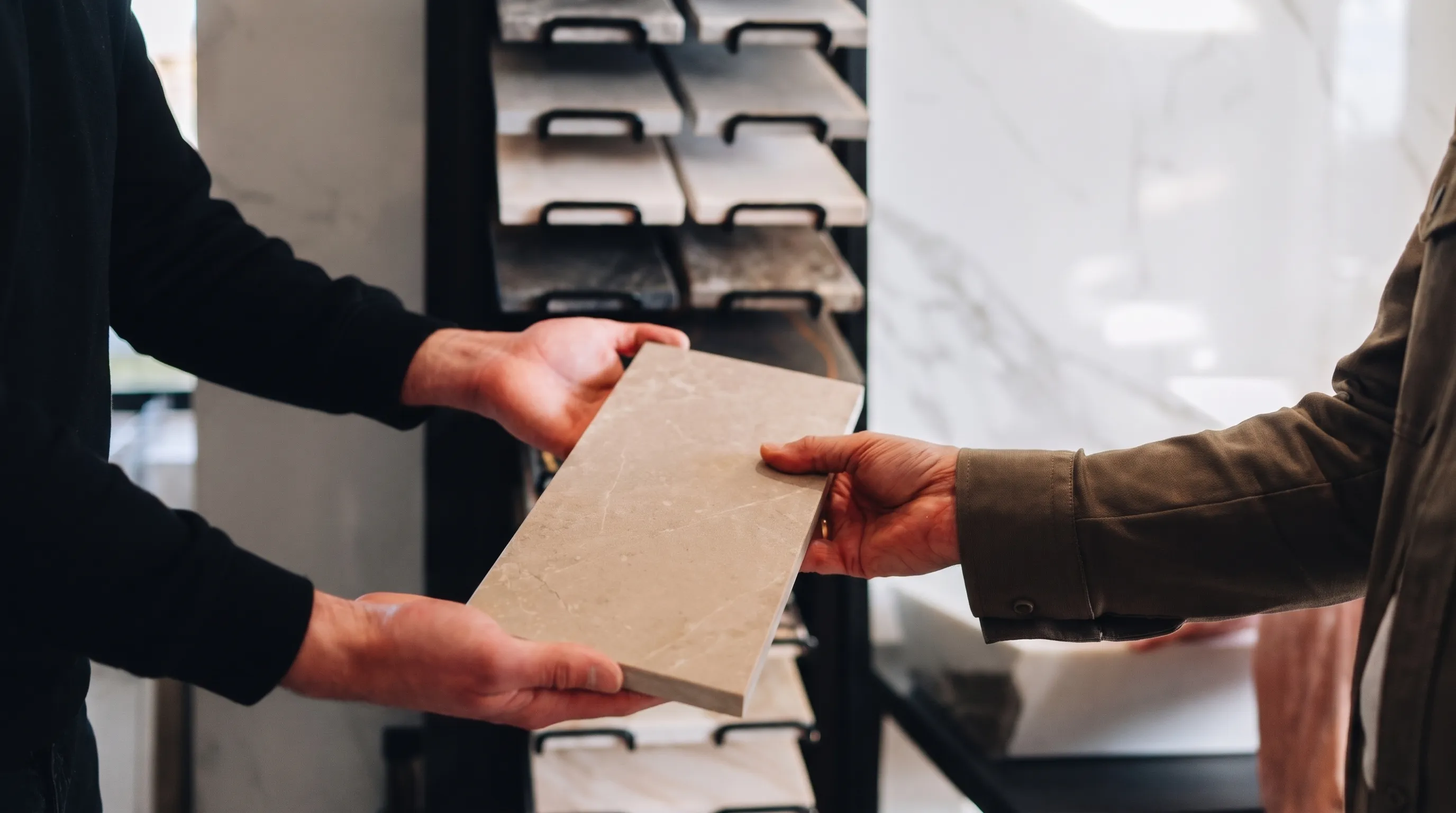
How to check a slab in a showroom for authenticity and finish quality
For marble, it helps to view the tabletop at an angle, not just from above — side light on a poorly polished surface reveals microscopic unevenness invisible under ordinary overhead shop lighting. For porcelain stoneware, running a hand along the slab’s cut edge is useful — quality sintered material should look uniform in colour through the cut, with no visible layers or voids that betray a cheaper, less dense production process.
The price gap
Quality porcelain stoneware for a tabletop usually runs 20–40% cheaper than comparably sized marble — the gap reflects not just raw material but the complexity of working natural stone: cutting, grinding and polishing a marble slab takes more of a craftsman’s time and carries a higher defect risk from natural fissures in the stone invisible before work begins. Porcelain’s factory process is standardised, and the finished slab’s quality is predictable from the moment a specific batch is chosen.
Sustainability and material origin
Marble is a finite natural resource, and quarrying it carries a noticeable landscape impact at the extraction site, while porcelain stoneware is made from widely available minerals — clay, kaolin, feldspar — much the same as ordinary ceramic tile, just fired differently. For clients who weigh this specifically, porcelain stoneware is the more predictable choice in terms of raw-material origin.
Can both materials be combined in one interior
Yes, and it is common practice — a daily dining table in porcelain stoneware, with a separate accent side table or console in the living room, seeing minimal load, made in marble for its unique pattern. This zoning by room and use case delivers practicality where it is needed daily and a striking material where stain risk is minimal.
Resistance to temperature swings
A hot pan set directly on the tabletop without a trivet is a classic kitchen moment, risky in different ways for each material. Porcelain stoneware, fired at temperatures far above anything a kitchen produces, handles brief heat contact with almost no consequence. Marble is more sensitive to sudden localised heating — microcracks, not visible right away, can form from the contrast between a hot spot and the surrounding cool surface rather than from the heat itself.
Trivets are technically mandatory for both in theory, but in practice this rule cannot be broken for marble, while porcelain forgives the occasional lapse with no visible consequence — part of why it earns a reputation as the more forgiving everyday material.
Restoration: what happens with serious damage
A chip or crack in a marble top is usually repairable: a stone specialist grinds and polishes the damaged area, largely restoring the look, though a faint line sometimes remains on close inspection. A crack in porcelain stoneware repairs less well — its sintered structure does not respond to local grinding the way natural stone does, and serious damage more often means replacing the whole slab or a large section rather than a local fix.
This nuance rarely comes up in the material conversation, but is worth remembering for a table that gets moved often or travels between a dacha and a city flat — the risk of an accidental corner knock is higher there than for a table that stays put in one room.
Care: a different philosophy, not just a different frequency
Marble care is built on prevention — a yearly sealant and the habit of wiping spills before acid can soak into the pores. Porcelain stoneware care is built on simplicity — a damp cloth and an ordinary household product, no special measures. That difference in philosophy, not just the end result, decides which material suits a given family: are household members willing to remember prevention, or do they prefer a material that forgives inattention?
Comment from a KALLEN HOME workshop craftsman
"Clients often pick marble from a photo, then it turns out the table is for a daily kitchen with kids — in that case we honestly recommend porcelain and show collections with a convincing marble-pattern imitation. For a formal table seeing guests on holidays, marble remains the clear winner — its strengths show fully there, and its weaknesses barely get the chance to appear," says the workshop team.
By their observation, the final choice almost never comes down to which material is "better" in absolute terms — both excel in their own role, and the mistake almost always comes not from the material itself but from choosing it for the wrong use case.
If the choice still wavers after all the arguments, the honest way to decide is to picture not the last beautiful table seen in someone else’s photographed interior, but what actually happens on your own table every evening — breakfast with kids, work papers, an occasional festive dinner. The answer to that simple question almost always matches the right material choice.
Both marble and porcelain stoneware, correctly matched to the actual use case, last decades — problems arise almost only where a material was chosen from a photo without first thinking through how that table would actually live in the home day to day.
At the order stage, the workshop usually asks about the table’s actual use scenario, not just the desired colour and shape — a short conversation that takes a couple of minutes at the brief but saves disappointment a year later, once the table is living its real life at home rather than the one imagined at the choosing stage.
A third option rarely mentioned: engineered quartz
Between marble and porcelain stoneware, a third material is sometimes overlooked — engineered quartz, made from crushed quartz and resin. It barely stains from acid like porcelain, while feeling warmer and more stone-like to the touch than porcelain’s cool, glassy surface. Its downside is sensitivity to prolonged direct sun — the resin binder can yellow slightly on a south-facing windowsill over several years, unlike pure porcelain.
For a table standing by a sunny window, this makes engineered quartz a less obvious choice than it first appears — despite its practicality against acids, light-fastness turns out to be its weak point, rarely mentioned in engineered-stone makers’ own marketing.
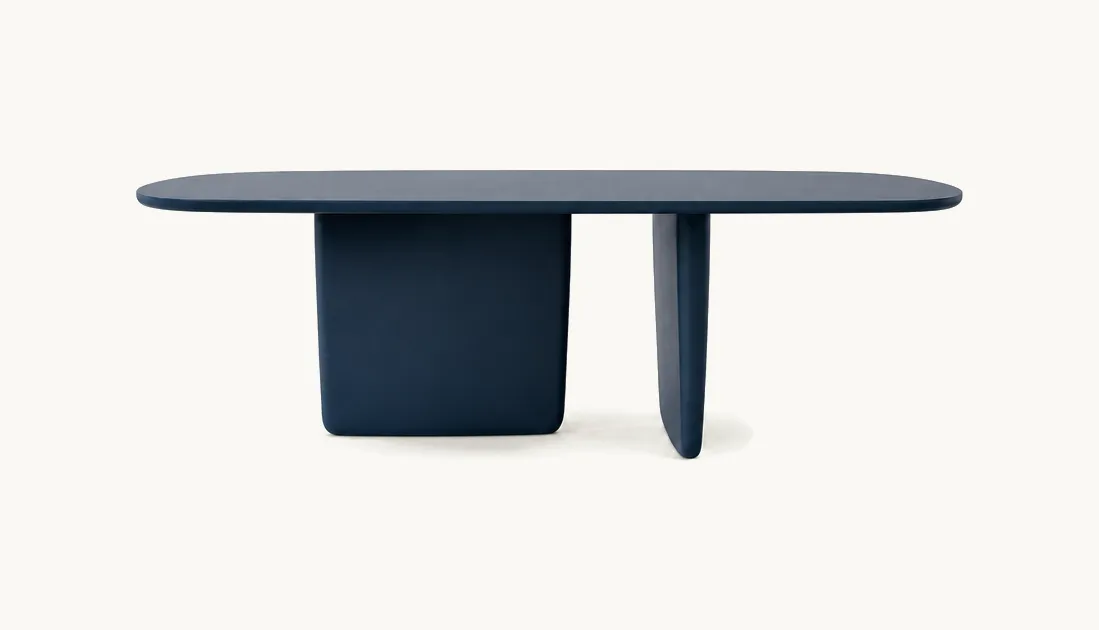
See the SKAI table in the catalog
Frequently asked questions
Does marble’s protective sealant need renewing?
Yes, once a year — this maintains stain resistance; porcelain stoneware needs no such sealant.
Does porcelain stoneware scratch from a knife?
It is noticeably harder than marble on the Mohs scale, but we still recommend a cutting board — not to protect the tabletop, but the knife blades.
Which material is heavier?
Marble is usually heavier at the same thickness — worth factoring into the base choice, especially a slim sculptural leg.
How much cheaper is porcelain stoneware than marble?
Usually 20–40% at comparable size — the gap reflects the complexity and defect risk of working natural stone.
Can both materials be used in one home?
Yes, common practice — porcelain for a daily dining table, marble for an accent table or console with minimal load.