An adjustable desk and chair cost less over years than replacing furniture every 2–3 years, and child-room materials should be safe and easy to clean above all.
The number to start from: 15–20 cm in two or three years
A school-age child typically grows 15–20 cm in two or three years — more than many adjustable ranges cover, but far less than the furniture budget if a chair and desk are replaced every time the old ones get small.
In money terms, a fixed children’s chair costs roughly a third of a growing one but gets bought two or three times over school years, while the growing one is bought once — over 7–10 years, the adjustable option usually wins on total spend despite the higher starting price.
What actually adjusts, and what does not
Growing furniture adjusts specific parameters — seat height, footrest height, desktop height, and in better models seat and desktop tilt. Seat width and depth are usually fixed for an average growth range, which is fine: height, not width, is what determines correct posture.
- Seat height — the main, most-adjusted parameter
- Footrest height — must move with the seat, not separately
- Desktop height — synced to the chair, not set arbitrarily
- Desktop tilt — in writing/drawing models, not every growing set
The European school-furniture standard as a home benchmark
European standard EN 1729 governs school furniture: Part 1 sets functional dimensions by height group (sizemarks 0–6), Part 2 covers safety and test methods including stability, with extra requirements for the youngest sizemarks (0 and 1).
A bespoke maker is not required to certify against this standard the way school suppliers are, but following its height ranges and stability logic is sound practice — it reflects accumulated evidence, not abstract paperwork.
Stability: three directions of testing, not one
EN 1729-2 tests stability forward, sideways and backward — reflecting how children actually move: rocking, leaning on one armrest, standing up abruptly. Sideways and backward are where falls most often happen for children, who control their weight less precisely than adults.
Worth asking the workshop directly whether all three directions are checked, not just a static top-down load — the answer shows how seriously child-specific safety is actually handled, versus a scaled-down adult chair.
Materials: what to check before, not after, ordering
Upholstery dye should be certified free of heavy metals, available on request. Wood finish needs to withstand frequent damp wiping — children’s furniture gets cleaned far more often than adult furniture, and a finish meant for occasional dry dusting wears off armrests and desktops within a year or two.
The simplest check is not reading a description but asking for a sample on the spot — wipe it wet, press a fingernail into the finish, see if it marks. A minute tells you more than any product page.
Posture and desktop tilt — an easy detail to underrate
A tilted desktop for writing is not decoration — it reduces neck strain versus a flat surface, since less forward head tilt is needed. A horizontal surface suits a laptop or building blocks better, where tilt gets in the way.
If only one adjustment fits the budget — tilt or height — height almost always matters more; the wrong height affects posture faster and more visibly than missing tilt, which a book stand can temporarily compensate for.
Stability matters more than looks, especially for the chair
A child’s chair must withstand rocking and not tip under a sudden sideways weight shift — checked with a load test, but with a stricter margin than adult furniture: a slightly wider base and lower centre of gravity, even when the proportions look like a minor detail.
What to ask the workshop before ordering
- What growth range the seat/desk/footrest adjustment actually covers, in numbers
- Is there a heavy-metal-free dye certificate, and can it be shown
- Is stability checked in three directions, not just top-down
- What wood finish is used, and is it rated for frequent damp wiping
How the adjustment actually works: three mechanisms, not one
Behind the word "adjustable" sit different mechanisms with different lifespans. Telescoping rails with a locking screw or ratchet are most common for seat and footrest height — a stepped 2–3 cm adjustment, mechanically simple and near maintenance-free. A gas-lift, familiar from office chairs, gives smooth adjustment but suits children’s furniture less well — smoothness matters less than firm, months-long fixation at one height.
A third option is a set of swappable inserts or blocks, physically moved up a notch once a season or year — the simplest, most mechanically reliable option, since no moving parts means nothing to loosen over years of use. The trade-off is that an adult has to do it, not the child with one lever.
The real cost over time, not just in principle
In concrete numbers: a non-adjustable children’s chair costs roughly a third of a growing model of the same material quality, but gets rebought once or twice over school years as the child outgrows it. The growing model is bought once. Over 7–10 years, three purchases of a fixed chair almost always exceed one growing model’s price, even at 1.5–2x the starting cost.
The same logic applies to the desk: a fixed-height desk sized "for now" creates poor posture within two or three years even if the desk itself is physically fine — it simply stops fitting the proportions. The real comparison is the cost of correct posture across all school years, not one item’s price tag.
Common mistakes when choosing growing furniture
The most common mistake is adjusting only the chair or only the desk, not both — within a year or two their heights drift apart. The second is trusting the look of the mechanism over the actual range in centimetres: two chairs can look equally "growing" while one adjusts 8 cm and the other 20.
When growing furniture genuinely is not worth it
In fairness, growing furniture is not always worth it. For a child already close to adult height — roughly 13–14 and up, over 160 cm — the remaining growth window is too short to justify the mechanism’s premium; adult-proportioned furniture sized for current height makes more sense.
A KALLEN HOME technologist’s view
"We build more stability margin into children’s chairs than adult models of the same seat height — kids control sudden movement less precisely, and that belongs in the design, not in a ‘sit still’ rule," says a KALLEN HOME technologist.
A practical production tip: do not order right at the top of the projected growth range — leave 5–8 cm of headroom, since growth spurts rarely follow an even schedule.
By the technologists’ observation, a chair and desk bought with headroom and readjusted at least once a year serve without a single posture complaint through most school years — the real risk is forgetting to move the adjustment, not the mechanism itself.
The simple habit that makes all this calculation pay off
Upholstery seams and fastenings on growing furniture also deserve a note: joints that get taken apart and reassembled for a new height take more mechanical stress over the years than a fixed chair’s, so workshops build in reinforced stitching and sturdier fabric-to-frame fastening from the start, not after a complaint two years in.
It is worth clarifying in advance who actually performs the height change — a parent with a simple lever, or a mechanism needing a craftsman’s visit. For families who prefer frequent small adjustments rather than one big yearly jump, a tool-free mechanism matters more.
With several children of different ages, a growing set has an extra benefit rarely factored in: the same desk and chair can pass to a younger sibling by simply dialling the adjustment back down, instead of buying new furniture from scratch for each child.
All of the above only works if the adjustment is actually checked once a season, not once at purchase. The easiest anchor is an existing family ritual — back-to-school shopping, or spring clothes-sizing — twice a year, five minutes checking knee and elbow angles, which is the "regular care" without which even the best growing furniture quietly stops doing its job.
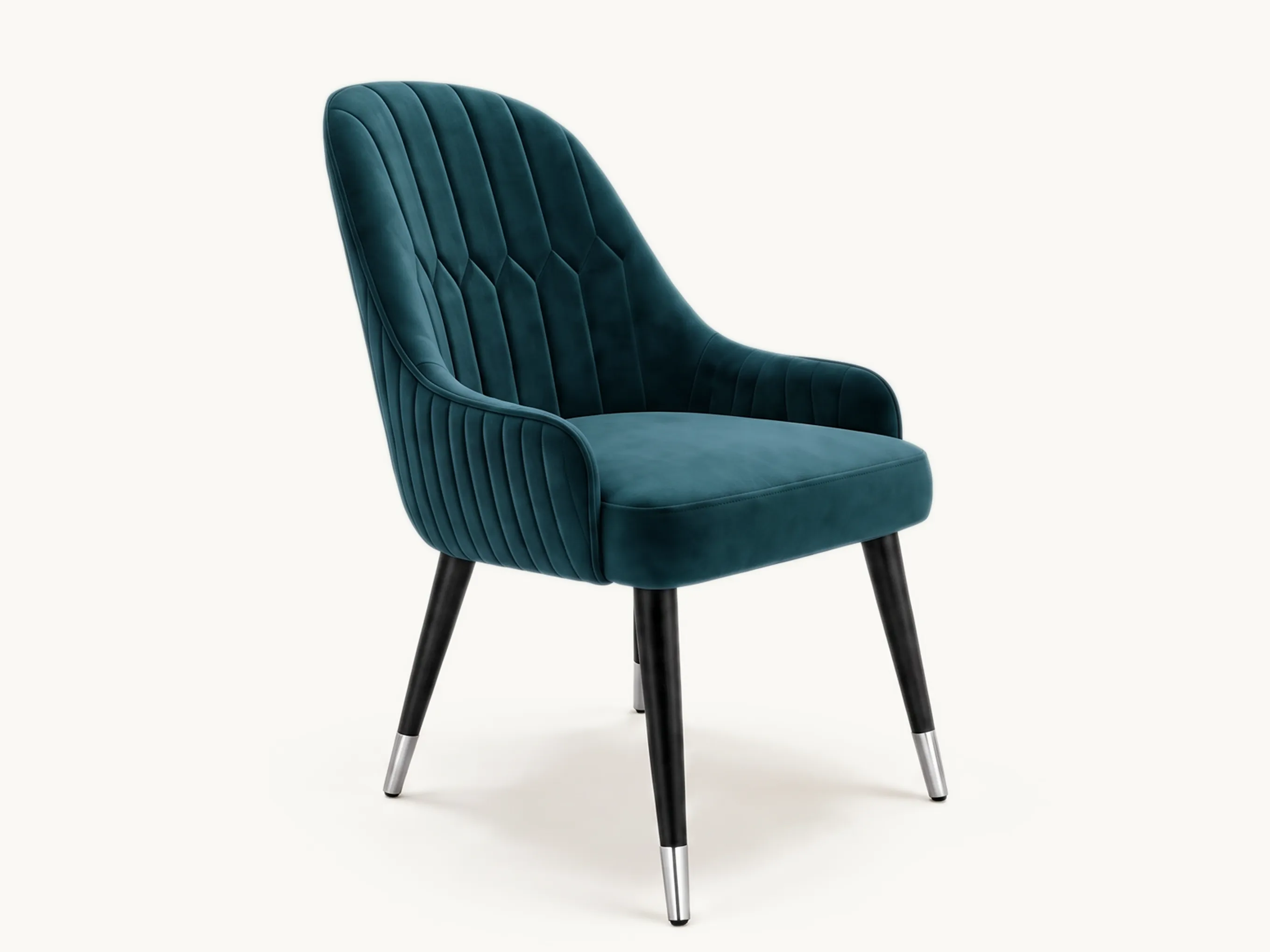
See the MILAN chair in the catalog
Frequently asked questions
From what age does an adjustable chair make sense?
Usually from the start of school age, around 6–7, when time spent at a desk becomes regular rather than occasional.
Can a custom colour be chosen for a child’s room?
Yes, colour and fabric are chosen individually, as for any KALLEN HOME model.
Is the upholstery easy to clean of markers and paint?
For children’s furniture we recommend stain-treated fabrics — this makes care easier, though it does not make the fabric immune to stains.
Which European standard guides children’s furniture design?
EN 1729 for school furniture — its height ranges and stability requirements serve as a benchmark even outside educational settings.
How much headroom should the height adjustment leave?
5–8 cm beyond the current growth projection — growth spurts are uneven, and a small margin avoids an unplanned purchase.